>
Gobiiformes (Gobies) >
Gobiidae (Gobies) > Gobiinae
Etymology: Trimma: Greek, trimma, -atos = something crushed (Ref. 45335); tevegae: Named for the American research vessel 'Te Vega', a converted luxury yacht, operated at the
time the type specimens were collected in 1965 by Stanford University's Hopkins Marine Station.
Eponymy: The ‘Te Vega’ is Stanford University’s research vessel; a converted luxury yacht, from which the type was collected. (Ref. 128868), visit book page.
More on authors: Cohen & Davis.
สิ่งแวดล้อม : สิ่งแวดล้อม / เขตภูมิอากาศ / ระดับความลึก / ระยะการกระจายสินค้า
นิเวศวิทยา
เกี่ยวกับทะเล,น้ำเค็ม เกี่ยวกับหินโสโครก, usually 10 - 40 m (Ref. 27115). Tropical; 22°C - 26°C (Ref. 27115); 33°N - 18°S
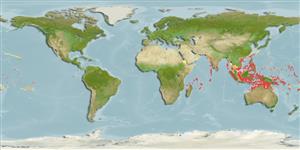
Western Pacific: from north-east Borneo and the northern Philippines southward to the Solomon Islands; apparently absent from Australian, Palauan and Japanese waters, but probably more widely distributed in Indonesia than currently documented.
ขนาด / น้ำหนัก / อายุ
วัยเจริญพันธุ์: Lm ? range ? - ? cm
Max length : 4.5 cm TL เพศผู้/กระเทย; (Ref. 9710)
คำอธิบายสั้นๆ
เครื่องมือที่ใช้ในการแยกชนิดสัตว์,สิ่งมีชีวิตออกจากกัน | สัณฐานวิทยา | ความยาวต่างๆ
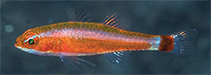
เงี่ยงครีบหลัง (รวม) : 7; ก้านครีบอ่อนที่หาง (รวม) : 8 - 9; เงี่ยงครีบก้น: 1; ก้านครีบอ่อนที่ก้น: 8 - 9. Characterized by golden brown body color; white on lower head and ventral body; presence of lavender or bluish lateral stripe from upper eye to middle of caudal peduncle; caudal fin base with large dark blotch; elongate and filamentous second dorsal spine; all pectoral rays unbranched; fifth pelvic ray unbranched; longitudinal scale series 25-26; predorsal scales about 12; cheek and opercle without scales; depth of body about 4.0-4.4 in SL (Ref. 90102).
Body shape (shape guide): fusiform / normal.
Inhabits coastal to outer reefs, typically in small groups in caves (Ref. 48637). Forms loose aggregations associated with shallow pockets and caves of steep drop-offs. Hovers in a head-up position (often vertical, posture in the water column) and feeds on copepods (Ref. 1602, 58123).
วงจรชีวิตและพฤติกรรมการผสมพันธุ์
วัยเจริญพันธุ์ | การสืบพันธุ์ | การวางไข่ | เซลสืบพันธ์ของเพศเมีย(ไข่) | ความดกของไข่ | ตัวอ่อน
Winterbottom, R., 2016. Trimma tevegae and T. caudomaculatum revisited and redescribed (Acanthopterygii, Gobiidae), with descriptions of three new similar species from the western Pacific. Zootaxa 4144(1):001-053. (Ref. 109919)
สถานะบัญชีแดงของ IUCN (Ref. 130435: Version 2025-2 (Global))
ภัยคุกคามต่อมนุษย์
Harmless
การใช้ของมนุษย์
การประมง: การค้า; สถานที่แสดงสัตว์และพืชน้ำ: การค้า
เครื่องมือ
รายงานพิเศษ
ดาวน์โหลด XML
แหล่งที่มาจากอินเตอร์เน็ต
การประมาณค่าตามแบบจำลอง
อุณหภูมิที่ต้องการ (อ้างอิง
123201): 26.2 - 28.9, mean 27.9 °C (based on 464 cells).
ดัชนีความหลากหลายทางวิวัฒนาการ (อ้างอิง
82804): PD
50 = 0.5000 [Uniqueness, from 0.5 = low to 2.0 = high].
Bayesian length-weight: a=0.01023 (0.00477 - 0.02194), b=3.01 (2.83 - 3.19), in cm total length, based on LWR estimates for this (Sub)family-body shape (Ref.
93245).
ระดับชั้นอาหาร (อ้างอิง
69278): 3.0 ±0.00 se; based on food items.
ความสามารถในการกลับคืนสู่ปกติ (อ้างอิง
120179): ความสูง, เวลาต่ำสุดที่จะทำให้ประชากรเพิ่มขึ้นเป็น 2 เท่าใช้เวลาน้อยกว่า 15 เดือน (Preliminary K or Fecundity.).
ความเสี่ยงต่อการตกปลา (Ref.
59153): Low vulnerability (10 of 100).
🛈
สารอาหาร (Ref.
124155): Calcium = 228 [114, 540] mg/100g; Iron = 1.24 [0.61, 2.36] mg/100g; Protein = 18.2 [16.2, 19.9] %; Omega3 = 0.169 [0.071, 0.347] g/100g; Selenium = 28.4 [12.8, 61.8] μg/100g; VitaminA = 120 [32, 419] μg/100g; Zinc = 2.96 [1.85, 4.49] mg/100g (wet weight);