Teleostei >
Anguilliformes (Eels and morays)
鰻目 (Eels and morays) >
Anguillidae (Freshwater eels)
鰻鱺科(Freshwater eels) (Freshwater eels)
Etymology: Anguilla: Latin, anguilla, .-ae = eel (Ref. 45335).
More on authors: Quoy & Gaimard.
环境:氛围 / 气候带 / 深度上下限 / 分布范围
生态学
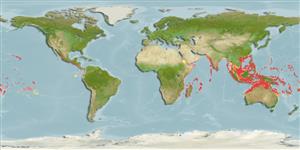
海洋; 淡水; 半咸淡水 居于水底的; 降海洄游 (Ref. 138280); 深度上下限 0 - 3000 m (Ref. 86942). 热带; 46°N - 35°S, 18°E - 89°W
Indo-Pacific: from Western Cape, South Africa, inland Mozambique and lower Zambezi River to French Polynesia, north to southern Japan, east to Galapagos. Also rivers of Madagascar and adjacent islands (Ref. 52193).
印度-太平洋: 东非到法属玻里尼西亚, 北至日本南部。 非洲: 内陆的莫桑比克与尚比西河下游河。
大小 / 重量 / 年龄
成熟度: Lm ? range ? - ? cm
Max length : 70.0 cm TL 雄鱼/尚未辨别雌雄; (Ref. 57749); 200.0 cm TL (female); common length : 26.3 cm TL 雄鱼/尚未辨别雌雄; (Ref. 35840); 最大体重: 20.5 kg (Ref. 13337); 最大体重: 20.5 kg; 最大年龄: 40 年 (Ref. 48660)
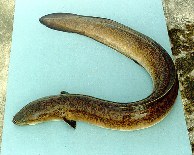
脊椎骨: 100 - 110. Diagnosis: Distinguished from all other species by the mottled colour and the long dorsal fin, which begins closer to the gill opening than to the anus (Ref. 9828).
Body shape (shape guide): eel-like.
在灰黄色的背景上的他们的背部上成鱼有一个褐色或黑色的大理石纹。 这一个颜色能逐渐褪色。 白色的腹面。 较年青的标本是略灰色的到橘色的与大理石纹是比较不看得见.(参考文献 48622) 体色褐色小的斑点散布在背面,侧边与鳍上; 在小的斑点与胸鳍的边缘之间的黄色; 腹部白色或蓝灰色.(参考文献 45563) 头部圆的; 吻扁平的; 下颌伸出; 鳃裂小的; 鳞片像缠结的一样在皮肤下面; 胸鳍圆的; 腹鳍不存在。 (参考文献 45563) 与所有的其他种区分了藉由斑点的颜色与长的背鳍, 超过到肛门起点较靠近鳃裂.(参考文献 9828)
Live in freshwater areas as adults, estuaries and seas as young (Ref. 12693). Found in lowland rivers as well as upland tributaries (Ref. 2847). While in river, the sex gland does not develop. But in winter when they move from the stream to river mouth, the sex gland begins to develop as mature individuals go to deep sea to breed (Ref. 45563). The spawning grounds are deep sea gullies among the south of the Philippines, east of Indonesia and Papua New Guinea (Ref. 45563). Are active at night, feeding on a wide range of prey (Ref. 7248, 79840), especially crabs, frogs and fish (Ref. 7248). Thought to breed east of Madagascar where the young are wafted to the East Coast by ocean currents (Ref. 13337, 79840).
当成鱼时生活在淡水水域, 当幼鱼时的河口与海洋.(参考文献 12693) 发现于低地的河了以及丘陵地支流.(参考文献 2847) 在河中的时候, 鱼的性别腺不会发育而冬天时它跟随溪流到河口在哪里性别腺开始发育,而且然后它去到深的海洋繁殖.(参考文献 45563) 它的产卵场是在菲律宾南方, 印度尼西亚以东与巴布亚新几内亚之中的深海洋小峡谷。 (参考文献 45563) 栖息于深的岩石水池而且是活跃的在晚上,吃宽范围的猎物, 尤其螃蟹,青蛙与鱼.(参考文献 7248) 一般认为繁殖于幼鱼被洋流浮动到东海岸的马达加斯加东方了。 (参考文献 13337)
生命周期和交配行为
成熟度 | 繁殖 | 产卵场 | 卵 | 孕卵数 | 仔鱼
印度-太平洋: 东非到法属玻里尼西亚, 北至日本南部。 非洲: 内陆的莫桑比克与尚比西河下游河。
Castle, P.H.J., 1984. Anguillidae. p. 34-37. In J. Daget, J.-P. Gosse and D.F.E. Thys van den Audenaerde (eds.) Check-list of the freshwater fishes of Africa (CLOFFA). ORSTOM, Paris and MRAC, Tervuren. Vol. 1. (Ref. 3506)
世界自然保护联盟红皮书 (Ref. 130435: Version 2025-2 (Global))
人类利用
渔业: 商业性; 养殖: 商业性; 游钓鱼种: 是的
工具
特别资料
下载 XML
网络资源
基于模型的估算
首选温度 (参考文献
123201): 15.7 - 27.8, mean 24.5 °C (based on 725 cells).
系统发育多样性指数 (参考文献
82804): PD
50 = 0.5000 [Uniqueness, from 0.5 = low to 2.0 = high].
Bayesian length-weight: a=0.00076 (0.00037 - 0.00155), b=3.17 (3.00 - 3.34), in cm total length, based on LWR estimates for this Genus-body shape (Ref.
93245).
营养阶层 (参考文献
69278): 3.8 ±0.67 se; based on food items.
Generation time: 2.2 ( na - na) years. Estimated as median ln(3)/K based on 1
growth studies.
回复力 (参考文献
120179): 非常低的, 最小族群倍增时间超过14 年 (tmax=40).
渔业脆弱性 (Ref.
59153): Moderate vulnerability (42 of 100).
🛈