>
Kurtiformes (Nurseryfishes, cardinalfishes.) >
Apogonidae (Cardinalfishes) > Apogoninae
Etymology: Fibramia: Latin 'fibra' meaning thread or filament and the feminine Greek 'amia' often applied as an ending for some cardinalfish genera as well as an incorrect past usage as a cardinalfish genus. The name refers to two characteristics of the species in this genus, an elongate second dorsal spine in one species and the narrow, pale or dark mid-line on the body of two species.
More on author: Cuvier.
Ambiente: milieu / zona climatica / distribuzione batimetrica / gamma di distribuzione
Ecologia
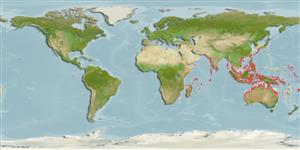
marino associati a barriera corallina; non migratori; distribuzione batimetrica 0 - 20 m (Ref. 48635), usually 0 - 12 m (Ref. 90102). Tropical
Indo-Pacific: south to Natal, South Africa (Ref. 4329) and east to western Pacific.
Dimensione / Peso / Età
Maturità: Lm ? range ? - ? cm
Max length : 8.5 cm TL maschio/sesso non determinato; (Ref. 90102)
Breve descrizione
Chiavi di identificazione | Morfologia | Morfometria
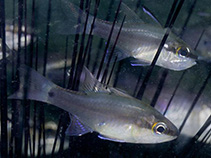
Spine dorsali (totale) : 7; Raggi dorsali molli (totale) : 9; Spine anali: 2; Raggi anali molli: 8. Black stripe from snout through eye to angle of opercle; tip of 1st dorsal present; caudal spot present (Ref. 4329, 48635). Sometimes has yellow barring on sides (Ref. 48635). 2-3 tiny black spots along base of dorsal fin; greatest depth of body 2.6-3.0 in SL (Ref. 90102).
Body shape (shape guide): elongated; Cross section: compressed.
Found in deep coastal reefs (Ref. 8631). Form small schools with outcrops on reef on sand to depths of 20 m (Ref. 48635); or among rocks or corals of shallow sheltered lagoons (Ref. 7300); often in seagrass beds (Ref. 37816). A nocturnal species (Ref. 7300).
Ciclo vitale e comportamento di accoppiamento
Maturità | Riproduzione | Deposizione | Uova | Fecondità | Larve
Mouthbrooders (Ref. 240). Distinct pairing during courtship and spawning (Ref. 205).
Kailola, P.J., 1991. The fishes of Papua New Guinea: a revised and annotated checklist. Vol. III. Gobiidae to Molidae. Research Bulletin No. 41, Research Section, Dept. of Fisheries and Marine Resources, Papua New Guinea. 153 p. (Ref. 6771)
Stato della Lista Rossa IUCN (Ref. 130435: Version 2025-2 (Global))
Minaccia per l'uomo
Harmless
Usi umani
Pesca: scarso interesse commerciale; Acquario: Commerciale
Strumenti
Rapporti speciali
Scarica XML
Fonti Internet
Stime basate su modelli
Temperatura preferita (Fonte Biblio.
123201): 24.9 - 29.3, mean 28.5 °C (based on 2879 cells).
Indice di diversità filogenetica (Fonte Biblio.
82804): PD
50 = 0.6250 [Uniqueness, from 0.5 = low to 2.0 = high].
Bayesian length-weight: a=0.00692 (0.00302 - 0.01587), b=3.22 (3.02 - 3.42), in cm total length, based on LWR estimates for this (Sub)family-body shape (Ref.
93245).
Livello trofico (Fonte Biblio.
69278): 3.5 ±0.50 se; based on food items.
Resilienza (Fonte Biblio.
120179): Alto, tempo minimo di raddoppiamento della popolazione meno di 15 mesi (Preliminary K or Fecundity.).
Vulnerabilità della pesca (Ref.
59153): Low vulnerability (10 of 100).
🛈
Nutrienti (Ref.
124155): Calcium = 202 [104, 376] mg/100g; Iron = 1.09 [0.59, 1.88] mg/100g; Protein = 18.5 [17.4, 19.7] %; Omega3 = 0.103 [0.055, 0.201] g/100g; Selenium = 32.3 [14.1, 73.2] μg/100g; VitaminA = 81.2 [24.5, 255.6] μg/100g; Zinc = 2.32 [1.45, 3.50] mg/100g (wet weight);