Περιβάλλον: περιβάλλον / κλιματική ζώνη / εύρος βάθους / εύρος διανομής
Οικολογία
Θαλασσινό(ά); Γλυκού νερού; Υφάλμυρο βενθικό(ς); κατάδρομος (Ref. 138274). Tropical; 22°N - 27°S
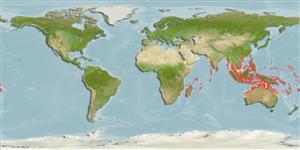
Indo-Pacific: widespread in the tropical Indian Ocean and western Pacific. Known in Australia only from streams in the Kimberley regions of northern western Australia. Africa: widespread but relatively uncommon along east and southeast African coast and Madagascar (Ref. 7248, 52193). Mozambique; Lower Zambezi River (Ref. 39494). Most easily confused with Anguilla obscura and the surest way to distinguish them is by the count of vertebrae (Ref. 9828).
Μέγεθος / Βάρος / Ηλικία
Γεννητική Ωρίμανση: Lm ? range ? - ? cm
Max length : 123 cm TL αρσενικό/απροσδιόριστο; (Ref. 6371); common length : 65.0 cm TL αρσενικό/απροσδιόριστο; (Ref. 2871); μεγ. αναφερόμενη ηλικία: 20 έτη (Ref. 48660)
Ραχιαίες άκανθες (συνολικά) : 0; Μαλακές ραχιαίες ακτίνες (συνολικά) : 240 - 245; Εδρικές άκανθες: 0; Μαλακές εδρικές ακτίνες: 200 - 220; Σπόνδυλοι: 105 - 115.
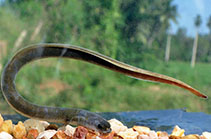
Body shape (shape guide): eel-like; Cross section: circular.
Adults inhabit freshwater streams and pools, preferring marshy habitats (Ref. 41236), in rivers and creeks, commonly over rock bottoms and in deeper pools and move as young to estuaries and seas (Ref. 12693). Seldom found in large rivers (Ref. 6028). Restricted to lowland (coastal) reaches of river systems (Ref. 7248). Adults descend to the sea to spawn (Refs. 52331, 79840). They feed on small fishes, crustaceans and mollusks. Reported to breed east of Madagascar; the south equatorial current probably carries the eel larvae and elvers towards the east coast of Africa where local coastal currents guide the elvers to suitable rivers which they invade and they stay there until sexually mature, when they return to their breeding grounds (Ref. 13337). Caught with various types of nets. Sometimes used in the aquarium trade (Ref. 6028).
Κύκλος ζωής και συμπεριφορά ζευγαρώματος
Γεννητική Ωρίμανση | Αναπαραγωγή | Γεννοβολία | Αβγά | Γονιμότητα | Προνύμφες
Kottelat, M., 2013. The fishes of the inland waters of Southeast Asia: a catalogue and core bibliography of the fishes known to occur in freshwaters, mangroves and estuaries. The Raffles Bulletin of Zoology 2013 (Suppl. 27):1-663. (Ref. 94476)
Κατάσταση Κόκκινου Καταλόγου IUCN (Ref. 130435: Version 2025-2 (Global))
Απειλή για τον άνθρωπο
Harmless
Ανθρώπινες χρήσεις
αλιεία: περιορισμένης εμπορικότητας
Εργαλεία
Ειδικές εκθέσεις
Λήψη XML
Διαδικτυακές πηγές
Εκτιμήσεις βάσει μοντέλων
Προτιμώμενη θερμοκρασία (Αναφ.
123201): 26.5 - 29.1, mean 28.3 °C (based on 1098 cells).
Δείκτης φυλογενετικής ποικιλότητας (Αναφ.
82804): PD
50 = 0.5000 [Uniqueness, from 0.5 = low to 2.0 = high].
Bayesian length-weight: a=0.00076 (0.00037 - 0.00155), b=3.17 (3.00 - 3.34), in cm total length, based on LWR estimates for this Genus-body shape (Ref.
93245).
Τροφικό Επίπεδο (Αναφ.
69278): 3.6 ±0.50 se; based on food items.
Ελαστικότητα (Αναφ.
120179): Χαμηλό, ελάχιστος χρόνος για διπλασιασμό πληθυσμού 4,5 - 14 έτη (tmax=20).
Ευπάθεια στην αλιεία (Ref.
59153): High to very high vulnerability (74 of 100).
🛈
Θρεπτικά συστατικά (Ref.
124155): Calcium = 58.7 [34.4, 111.3] mg/100g; Iron = 0.801 [0.472, 1.318] mg/100g; Protein = 18.8 [17.0, 20.8] %; Omega3 = 0.29 [0.14, 0.60] g/100g; Selenium = 150 [74, 289] μg/100g; VitaminA = 13.3 [3.1, 51.7] μg/100g; Zinc = 0.925 [0.650, 1.373] mg/100g (wet weight); based on
nutrient studies.