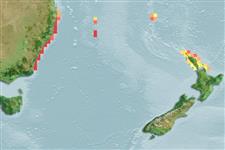
Entorno: milieu / zona climática / rango de profundidad / gama de distribución
Ecología
marino; salobre pelagic-neritic; rango de profundidad 0 - 20 m (Ref. 6390). Temperate; 28°S - 37°S
Southwest Pacific: eastern Australia from Moreton Bay, Queensland to Eden, New South Wales, including Lord Howe and Norfolk Islands.
Tamaño / Peso / Edad
Madurez: Lm ? range ? - ? cm
Max length : 39.8 cm SL macho / no sexado; (Ref. 10988)
Descripción breve
Claves de identificación | Morfología | Morfometría
Espinas dorsales (total) : 0; Radios blandos dorsales (total) : 15 - 17; Espinas anales: 0; Radios blandos anales: 17 - 20; Vértebra: 56 - 58. Preorbital canal with a posterior branch. Relatively longer jaws, especially at larger sizes. Gill rakers usually 34 or more in the first arch and usually 27 or more on the second arch.
Body shape (shape guide): elongated.
Found in sheltered bays, clear coastal waters and sometimes in estuaries (Ref. 27012). Generally herbivorous. Feed mainly on seagrasses and algal filaments (Ref. 26551, 27013). Eastern sea garfish also consume a high proportion of crustaceans (Ref. 27013). A schooling fish, found generally near the surface at night and close to the sea floor over seagrass beds during the day (Ref. 6390). They are being preyed upon by mulloway (Argyrosomus hololepidotus) and tailor (Pomatomus saltatrix), as well as coastal water birds. No studies have been reported on the spawning of this species (Ref. 6390).
Ciclo vital y comportamiento de apareamiento
Madurez | Reproducción | Puesta | Huevos | Fecundidad | Larva
Viviparous.
Collette, B.B., 1974. The garfishes (Hemiramphidae) of Australia and New Zealand. Records of the Australian Museum 29(2):11-105. (Ref. 10988)
Situación en la Lista Roja de la UICN (Ref. 130435: Version 2025-2 (Global))
Amenaza para el ser humano
Harmless
Usos humanos
Pesquerías: comercial; carnada: usually
Herramientas
Informes especiales
Descargar XML
Fuentes de Internet
Estimaciones basadas en modelos
Temperatura preferida (Referencia
123201): 18 - 23.4, mean 20.7 °C (based on 55 cells).
Índice de diversidad filogenética (Referencia
82804): PD
50 = 0.5000 [Uniqueness, from 0.5 = low to 2.0 = high].
Bayesian length-weight: a=0.00257 (0.00116 - 0.00571), b=3.09 (2.92 - 3.26), in cm total length, based on LWR estimates for this Genus-body shape (Ref.
93245).
Nivel trófico (Referencia
69278): 2.6 ±0.25 se; based on food items.
Resiliencia (Referencia
120179): Alto, población duplicada en un tiempo mínimo inferior a 15 meses (Preliminary K or Fecundity.).
Vulnerabilidad pesquera (Ref.
59153): Low vulnerability (23 of 100).
🛈