>
Cypriniformes (Carps) >
Danionidae (Danios) > Chedrinae
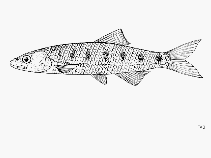
Etymology: salmolucius: The species name salmolucius is derived from the Latin salmo, meaning salmon, and the Latin lucius, meaning pike, and refers most probably to its general appearance (Ref. 122357).
More on authors: Nichols & Griscom.
Ambiente: milieu / zona climática / intervalo de profundidade / gama de distribuição
Ecologia
; Água doce bentopelágico; pH range: 7.4 - 8.0. Tropical; 21°C - 28°C (Ref. 122357)
Africa: restricted to main channel and the tributaries of the northern hemisphere of the Middle Congo basin, where it is widespread throughout the Aruwimi, Itimbiri, Tshopo, Lindi, Ubangi and Sangha rivers (Ref. 122357). Reports from Lower Congo (Ref. 57537) and Kasai River basin (Ref. 41591) refer to Raiamas brachyrhabdotos (Ref. 122357).
Tamanho / Peso / Idade
Maturidade: Lm ? range ? - ? cm
Max length : 16.4 cm SL macho/indeterminado; (Ref. 122357)
Descrição breve
Chaves de identificação | Morfologia | Morfometria
Espinhos dorsais (total) : 0; Raios dorsais moles (total) : 12; Espinhos anais: 0; Raios anais moles: 16 - 17; Vértebras: 38 - 40. Diagnosis: Within the Congo basin, Raiamas salmolucius is distinguished from R. batesii, R. kheeli and R. moorii by a lower number of lateral line scales, 42-46 vs. 68-70, 65-68 and 54-61 respectively; from R. longirostris by a greater head width, 36-43% of head length vs. 31%, a longer anal-fin base, 16.1-20.5% of standard length vs. 14.8%, and a deeper body, 19.8-23.3% of standard length vs. 16.5%; from R. buchholzi and R. christyi by the absence of a large dark spot at the base of the caudal fin vs. presence, and a longer dorsal-fin base, 14.1-14.9% of standard length vs. 10.1-12.0% and 10.4-11.6% respectively (Ref. 122357). Further, it is distinguished from the phenotypically similar species R. marqueti, R. intermedius and R. brachyrhabdotos by a longer head, 30.2-33.6% of standard length vs. 27.0-30.1%, 27.1-29.5% and 28.5-29.5% respectively; in addition, R. salmolucius is distinguished from R. marqueti by a shorter distance between the nostril and the eye, 5-6% of head length vs. 6-7%, overlap due to negative allometry, and the first two pigmented bars behind the pectoral fin being narrow and covering 1.5-2.0 lateral line scales vs. wide bars covering 2.5-3.0 lateral line scales, and from R. intermedius and R. brachyrhabdotos by a shallower body, 19.8-23.4% of standard length vs. 25.2-28.8% and 23.6-29.8% respectively, and a more or less horizontal predorsal profile vs. a convex predorsal profile (Ref. 122357). Outside the Congo basin, R. salmolucius is distinguished from all other species, except R. ansorgii, R. nigeriensis and R. senegalensis, by an intermediate number of lateral line scales, 42-46 vs. 36-38 in R. levequei, 58-63 in R. scarciensis and 39-42 in R. steindachneri; from R. ansorgii by a dorsal fin inserted slightly behind the insertion of pelvic fin, i.e. two or three lateral line scales between verticals through the anterior base of the dorsal fin and the pelvic-fin insertion vs. dorsal fin inserted well behind pectoral-fin origin, i.e. six lateral line scales; from R. nigeriensis by a longer head, 30.2-33.6% of standard length vs. 18.6-25.0%; and from R. senegalensis by a higher number of branched dorsal-fin rays, 9 vs. 8 (Ref. 122357).
Body shape (shape guide): elongated.
Found in river over a sandy substrate (Ref. 122357).
Ciclo de vida e comportamento de acasalamento
Maturidade | Reprodução | Desova | Ovos | Fecundidade | Larvas
Katemo Manda, B., J. Snoeks, A. Chocha Manda and E. Vreven, 2018. Hidden species diversity in Raiamas salmolucius (Teleostei: Cyprinidae) from the Congo basin: two new species based on morphometric evidence. Ichthyol. Explor. Freshwat. 28(4):345-363. (Ref. 122357)
Categoria na Lista Vermelha da IUCN (Ref. 130435: Version 2025-2 (Global))
Ameaça para o homem
Harmless
Utilização humana
Ferramentas
Relatórios especiais
Descarregue XML
Fontes da internet
Estimativas baseadas em modelos
Índice de diversidade filogenética (Ref.
82804): PD
50 = 0.5000 [Uniqueness, from 0.5 = low to 2.0 = high].
Bayesian length-weight: a=0.00589 (0.00280 - 0.01240), b=3.00 (2.82 - 3.18), in cm total length, based on LWR estimates for this (Sub)family-body shape (Ref.
93245).
Nível Trófico (Ref.
69278): 3.3 ±0.4 se; based on size and trophs of closest relatives
Resiliência (Ref.
120179): Médio, tempo mínimo de duplicação da população 1,4 - 4,4 anos (Preliminary K or Fecundity.).
Vulnerabilidade da pesca (Ref.
59153): Low vulnerability (10 of 100).
🛈