Umwelt: Milieu / Klimazone / Tiefenbereich / Verbreitungsgebiet
Ökologie
seewasser pelagic-neritic. Temperate
Southwest Pacific.
Größe / Gewicht / Alter
Geschlechtsreife: Lm ? range ? - ? cm
Max length : 30.0 cm TL Männchen/unbestimmt; (Ref. 30464)
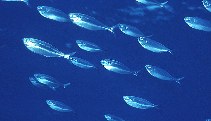
A plankton-picking species completely lacking teeth, they live in surface layers, rarely leaving the upper few meters of water, swimming rapidly and continuously (Ref. 30464).
Lebenszyklus und Paarungsverhalten
Geschlechtsreife | Fortpflanzung | Ablaichen | Eier | Fruchtbarkeit | Larven
Paxton, J.R., D.F. Hoese, G.R. Allen and J.E. Hanley, 1989. Pisces. Petromyzontidae to Carangidae. Zoological Catalogue of Australia, Vol. 7. Australian Government Publishing Service, Canberra, 665 p. (Ref. 7300)
IUCN Rote Liste Status (Ref. 130435: Version 2025-2 (Global))
Bedrohung für Menschen
Harmless
Nutzung durch Menschen
Tools
Zusatzinformationen
Download XML
Internet Quellen
Schätzungen auf der Grundlage von Modellen
Phylogenetischer Diversitätsindex (Ref.
82804): PD
50 = 0.7505 [Uniqueness, from 0.5 = low to 2.0 = high].
Bayesian length-weight: a=0.01380 (0.00567 - 0.03358), b=3.03 (2.81 - 3.25), in cm total length, based on LWR estimates for this (Sub)family-body shape (Ref.
93245).
Trophische Ebene (Ref.
69278): 3.4 ±0.4 se; based on size and trophs of closest relatives
Anfälligkeit der Fischerei (Ref.
59153): Low vulnerability (20 of 100).
🛈
Nährstoffe (Ref.
124155): Calcium = 53.5 [23.8, 107.4] mg/100g; Iron = 0.481 [0.263, 0.937] mg/100g; Protein = 18 [17, 19] %; Omega3 = 0.418 [0.207, 0.832] g/100g; Selenium = 8.49 [3.73, 20.12] μg/100g; VitaminA = 10.2 [2.1, 49.2] μg/100g; Zinc = 0.777 [0.501, 1.244] mg/100g (wet weight);