>
Blenniiformes (Blennies) >
Blenniidae (Combtooth blennies) > Salariinae
Etymology: Stanulus: Latin, stagnum, stannum = alloy of silver and tin (Ref. 45335).
Eponymy: Dr Frank Hamilton Talbot (b: 1930) is a fisheries scientist. [...] (Ref. 128868), visit book page.
Taxonomic Remarks
Tribe Salarinii
Ambiente: milieu / zona climática / intervalo de profundidade / gama de distribuição
Ecologia
marinhas associadas(os) a recifes; intervalo de profundidade 3 - 15 m (Ref. 9710). Tropical
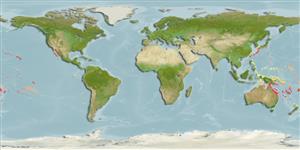
Western Pacific: Ryukyu and Ogasawara islands and the southern Great Barrier Reef and Lord Howe Island. Reported from Tonga (Ref. 53797) and the Marquesan Islands (Ref. 9710).
Tamanho / Peso / Idade
Maturidade: Lm ? range ? - ? cm
Max length : 4.8 cm TL macho/indeterminado; (Ref. 2334)
Descrição breve
Chaves de identificação | Morfologia | Morfometria
Espinhos dorsais (total) : 12; Raios dorsais moles (total) : 11 - 13; Espinhos anais: 2; Raios anais moles: 12 - 13. Distinguished from Entomacrodus by scalelike flaps on anterior portion of lateral line, fewer dorsal and anal fins, and more pectoral fin elements. Nasal, supraorbital and nuchal cirri simple and short. Both sexes without occipital crest.
Body shape (shape guide): elongated; Cross section: circular.
Adults are found in the surge channel zone of exposed outer reefs. Oviparous. Eggs are demersal and adhesive (Ref. 205), and are attached to the substrate via a filamentous, adhesive pad or pedestal (Ref. 94114). Larvae are planktonic, often found in shallow, coastal waters (Ref. 94114).
Ciclo de vida e comportamento de acasalamento
Maturidade | Reprodução | Desova | Ovos | Fecundidade | Larvas
Oviparous, distinct pairing (Ref. 205).
Randall, J.E., G.R. Allen and R.C. Steene, 1990. Fishes of the Great Barrier Reef and Coral Sea. University of Hawaii Press, Honolulu, Hawaii. 506 p. (Ref. 2334)
Categoria na Lista Vermelha da IUCN (Ref. 130435: Version 2025-2 (Global))
Ameaça para o homem
Harmless
Utilização humana
Pescarias: espécies comerciais; Aquário: Espécies comerciais
Ferramentas
Relatórios especiais
Descarregue XML
Fontes da internet
Estimativas baseadas em modelos
Temperatura preferida (Ref.
123201): 21.6 - 28.1, mean 26.1 °C (based on 683 cells).
Índice de diversidade filogenética (Ref.
82804): PD
50 = 0.7500 [Uniqueness, from 0.5 = low to 2.0 = high].
Bayesian length-weight: a=0.00776 (0.00354 - 0.01702), b=3.00 (2.81 - 3.19), in cm total length, based on LWR estimates for this (Sub)family-body shape (Ref.
93245).
Nível Trófico (Ref.
69278): 2.0 ±0.00 se; based on food items.
Resiliência (Ref.
120179): Elevada, tempo mínimo de duplicação da população menor que 15 meses (Preliminary K or Fecundity.).
Vulnerabilidade da pesca (Ref.
59153): Low vulnerability (10 of 100).
🛈
Nutrientes (Ref.
124155): Calcium = 277 [133, 555] mg/100g; Iron = 1.2 [0.6, 2.2] mg/100g; Protein = 17.7 [16.4, 18.9] %; Omega3 = 0.0906 [, ] g/100g; Selenium = 26.1 [10.7, 65.3] μg/100g; VitaminA = 114 [26, 506] μg/100g; Zinc = 3.72 [2.31, 5.66] mg/100g (wet weight);