>
Gobiiformes (Gobies) >
Gobiidae (Gobies) > Gobiinae
Etymology: Valenciennea: From Achille Valenciennes 1794-1865; he worked with Duméril, Cuvier and Lacepède since 1815; malacologist, author of a "Histoire naturelle des poissons" (Ref. 45335); parva: Species name from the Latin 'parvus', meaning dwarf.
Eponymy: Achille Valenciennes (1794–1865) was a French zoologist; primarily an ichthyologist and conchologist. [...] (Ref. 128868), visit book page.
More on authors: Hoese & Larson.
Taxonomic Remarks
Type locality: Lizard Island lagoon, Queensland, Australia.
Ambiente: milieu / zona climática / intervalo de profundidade / gama de distribuição
Ecologia
marinhas associadas(os) a recifes; não migratória (Ref. 52884); intervalo de profundidade 1 - 20 m (Ref. 90102). Tropical
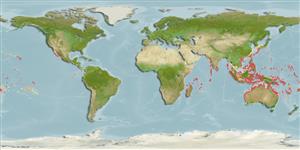
Indo-Pacific: Ashmore Reef, Maldives, and Seychelles to Oceania, north to Ryukyu Islands, south to the Great Barrier Reef.
Tamanho / Peso / Idade
Maturidade: Lm ? range ? - ? cm
Max length : 10.0 cm SL macho/indeterminado; (Ref. 48637)
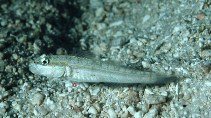
Espinhos dorsais (total) : 6 - 7; Raios dorsais moles (total) : 12; Espinhos anais: 1; Raios anais moles: 12. Characterized by pale grey body color; lower half of body with a pair of stripes linked by diffuse dark bars; faint dark grey bars/saddles on back; presence of blue-white stripe below eye to edge of gill opening, continued as white spot on upper pectoral fin base; without filamentous dorsal spines; rounded and short caudal fin, about equal to head length; longitudinal scale series 67-85; ctenoid body scales, becoming cycloid anteriorly below anterior part of first dorsal fin; without scales on head or midline of nape; side of nape with scales extending forward slightly anterior to above upper end of gill opening; scaleless pectoral fin base; partly scaled or scaleless prepelvic area; depth of body 5.7-6.6 in SL (Ref. 90102).
Body shape (shape guide): fusiform / normal.
Adults inhabit coastal and inner reef sand flats and slopes, often in large lagoons (Ref. 48637). They are found normally over clean, medium-grained sand patches interspersed with coral heads. They share habitats with the larger species such as V. longipinnis. Adults occur in pairs or small groups and has been observed in burrows. Monogamous (Ref. 52884). Observed to rock back and forth when moving near the burrow.
Ciclo de vida e comportamento de acasalamento
Maturidade | Reprodução | Desova | Ovos | Fecundidade | Larvas
Monogamous mating is observed as both obligate and social (Ref. 52884).
Hoese, D.F. and H.K. Larson, 1994. Revision of the Indo-Pacific gobiid fish genus Valenciennea, with descriptions of seven new species. Indo-Pac. Fish. (23):71 p. (Ref. 8527)
Categoria na Lista Vermelha da IUCN (Ref. 130435: Version 2025-2 (Global))
Ameaça para o homem
Harmless
Utilização humana
Ferramentas
Relatórios especiais
Descarregue XML
Fontes da internet
Estimativas baseadas em modelos
Temperatura preferida (Ref.
123201): 24.6 - 29.3, mean 28.3 °C (based on 2546 cells).
Índice de diversidade filogenética (Ref.
82804): PD
50 = 0.5000 [Uniqueness, from 0.5 = low to 2.0 = high].
Bayesian length-weight: a=0.01023 (0.00477 - 0.02194), b=3.01 (2.83 - 3.19), in cm total length, based on LWR estimates for this (Sub)family-body shape (Ref.
93245).
Nível Trófico (Ref.
69278): 3.2 ±0.3 se; based on size and trophs of closest relatives
Resiliência (Ref.
120179): Elevada, tempo mínimo de duplicação da população menor que 15 meses (Preliminary K or Fecundity.).
Vulnerabilidade da pesca (Ref.
59153): Low vulnerability (10 of 100).
🛈
Nutrientes (Ref.
124155): Calcium = 118 [63, 235] mg/100g; Iron = 0.803 [0.422, 1.464] mg/100g; Protein = 18.4 [16.4, 20.1] %; Omega3 = 0.142 [0.066, 0.245] g/100g; Selenium = 20.3 [11.2, 39.2] μg/100g; VitaminA = 138 [38, 430] μg/100g; Zinc = 2.02 [1.36, 2.97] mg/100g (wet weight);