Ikan bertulang rawan (sharks and rays) >
Myliobatiformes (Stingrays) >
Dasyatidae (Stingrays) > Urogymninae
Etymology: Pateobatis: Combination of Latin 'pateo' for 'lie open, be exposed' and 'batis' for skate, ray or flatfish; referring to the eclectic nature of members of this group.
More on authors: Jordan & Seale.
Lingkungan: lingkungan / zona iklim / kisaran kedalaman / jangkauan distribusi
Ekologi
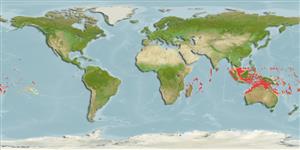
laut berasosiasi dengan karang; kisaran kedalaman 0 - 200 m (Ref. 86942). Tropical; 9°N - 26°S
Indo-West Pacific: widespread, from South Africa to the central Pacific Islands, north to Japan (Okinawa). Frequently confused with Himantura jenkinsii (Ref. 9840).
Panjang pada saat jatuh tempo pertama / Ukuran / Berat / umur
Kematangan: Lm 115.4, range 120 - ? cm
Max length : 183 cm TL jantan/; (Ref. 40637); Berat maksimum terpublikasi: 18.5 kg (Ref. 40637)
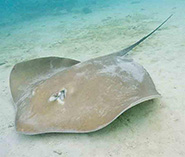
Uniformly tan to brownish pink dorsally. Inhabits lagoon and seaward sand flats from the intertidal to at least 200 m. Occurs in large aggregations (Ref. 37816).
Body shape (shape guide): other.
Occurs in aggregations over soft bottoms of the inner continental shelf, often near coral reefs (Ref. 9840). Ovoviviparous (Ref. 50449). Size at birth at about 55 cm WD (Ref. 6871). Feeds on fishes, crustaceans and molluscs (Ref. 89972). Common catch of the demersal tangle net, bottom trawl and, to a lesser extend, longline fisheries. Utilized for its meat, skin (high value) and cartilage (Ref.58048). By-catch of prawn trawlers (Ref. 6871).
Siklus hidup dan perilaku kawin
Kematangan | Reproduksi, perkembang biakan | Pemijahan | telur-telur | Fekunditas | Larva
Exhibit ovoviparity (aplacental viviparity), with embryos feeding initially on yolk, then receiving additional nourishment from the mother by indirect absorption of uterine fluid enriched with mucus, fat or protein through specialised structures (Ref. 50449). Distinct pairing with embrace (Ref. 205). Size at birth ~ 55 cm WD (Ref.58048).
Mould, B., 1994. A world list of rays. The scientific nomenclature and distribution of the recent Batoidea (Batoidea, Elasmobranchii, Chondrichthyes). University of Nottingham, [UK]. 82 p. (Ref. 8630)
Status IUCN Red List (Ref. 130435: Version 2025-2 (Global))
ancaman kepada manusia
Venomous
penggunaan manusia
Perikanan: nilai komersial kecil
Alat, peralatan
laporan khas
muat turun XML
Sumber internet
Estimasi berdasarkan model
Suhu yang disukai (Acuan
123201): 23.7 - 28.2, mean 26.7 °C (based on 471 cells).
Indeks keanekaragaman filogenetik (Acuan
82804): PD
50 = 0.5312 [Uniqueness, from 0.5 = low to 2.0 = high].
Bayesian length-weight: a=0.01023 (0.00482 - 0.02174), b=3.06 (2.86 - 3.26), in cm total length, based on LWR estimates for this (Sub)family-body shape (Ref.
93245).
Tingkat Trofik (Acuan
69278): 3.7 ±0.57 se; based on food items.
Daya lenting (Acuan
120179): Rendah, Waktu penggandaan populasi minimum 4.5 - 14 tahun (Assuming fecundity<100).
Kerentanan Penangkapan Ikan (Ref.
59153): Very high vulnerability (90 of 100).
🛈
Nutrisi (Ref.
124155): Calcium = 4.72 [0.53, 68.64] mg/100g; Iron = 0.359 [0.028, 3.857] mg/100g; Protein = 21.3 [18.7, 23.9] %; Omega3 = 0.0812 [, ] g/100g; Selenium = 45.3 [8.5, 225.5] μg/100g; VitaminA = 19.5 [1.6, 202.1] μg/100g; Zinc = 0.609 [0.036, 7.165] mg/100g (wet weight);