>
Acanthuriformes (Surgeonfishes) >
Acanthuridae (Surgeonfishes, tangs, unicornfishes) > Acanthurinae
Etymology: Acanthurus: Greek, akantha = thorn + Greek, oura = tail (Ref. 45335).
More on author: Linnaeus.
Umwelt: Milieu / Klimazone / Tiefenbereich / Verbreitungsgebiet
Ökologie
seewasser riff-verbunden; tiefenbereich 0 - 15 m (Ref. 27115), usually 1 - 3 m (Ref. 37792). Tropical; 24°C - 30°C (Ref. 27115); 36°N - 36°S, 27°E - 137°W
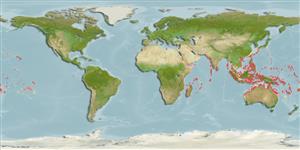
Indo-Pacific: East Africa, including the Mascarene Islands (Ref. 37792) to the Hawaiian, Marquesas and Tuamoto islands, north to southern Japan, south to the Great Barrier Reef and New Caledonia. Replaced by the closely related Acanthurus sohal in the Red Sea.
Länge bei der ersten Reifung / Größe / Gewicht / Alter
Geschlechtsreife: Lm 18.0 range ? - ? cm
Max length : 38.0 cm TL Männchen/unbestimmt; (Ref. 3145); common length : 25.0 cm TL Männchen/unbestimmt; (Ref. 30573); max. veröff. Alter: 46 Jahre (Ref. 27143)
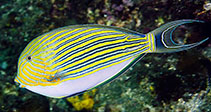
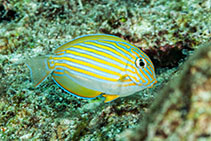
Rückenflossenstacheln (insgesamt) : 9; Rückenflossenweichstrahlen (insgesamt) : 27 - 30; Afterflossenstacheln: 3; Afterflossenweichstrahlen: 25 - 28. This species is distinguished by having the following characters: body deep and compressed, depth 2.1-3 times in standard length or SL (body of juveniles relatively deeper than that of adults); snout 5.2-5.7 times in SL; mouth small; teeth spatulate, close-set, with denticulate edges; total gill rakers on first gill arch 14-16; continuous unnotched dorsal fin IX,27-30 soft rays; A III,25-28; caudal fin deeply lunate with concavity 3.3-4.5 times in SL; a lancet-like spine on each side of caudal peduncle which folds into a deep horizontal groove, this spine long, 1.9-2.5 times in head length, and venomous; stomach thin-walled. Colour of body with upper 3/4 with alternating black-edged blue and yellow stripes and those on the head mainly diagonal; lower fourth pale lavender to bluish white; dorsal fin finely striped pale blue and yellowish; anal fin grey with a yellow basal band and a light blue margin; caudal fin blackish with a large, grey crescent centroposteriorly, edged at the front in bluish white and at the posterior margin with black; pectoral fins are pale except basally where they are coloured like the body; pelvic fins yellow-orange with a white lateral margin and a blackish submarginal line (Ref. 9808).
Body shape (shape guide): short and / or deep; Cross section: compressed.
Benthopelagic (Ref. 58302). Adults usually form schools and commonly found in shallow gutters. Juveniles solitary and secretive on shallow rubble habitats (Ref. 48637). A territorial species (Ref. 167) which is common in surge zones of exposed seaward reefs. The large male controls well-defined feeding territories and harems of females (Ref. 1602, 48637). The species is almost continually in motion. Herbivorous but also feeds on crustaceans (Ref. 5503). Forms spawning aggregations (Ref. 27825). Diurnal species (Ref. 113699:31); courtship takes place at various times of the day, spawning peaks in the morning, but may also occur from midday to afternoon, and is often confined to ebb tides (Ref. 38697). The venomous caudal spine can cause painful wounds.
Form spawning aggregations, but spawn in pairs (Ref. 27825).
Randall, J.E., 1986. Acanthuridae. p. 811-823. In M.M. Smith and P.C. Heemstra (eds.) Smiths' sea fishes. Springer-Verlag, Berlin. (Ref. 3145)
IUCN Rote Liste Status (Ref. 130435: Version 2025-2 (Global))
Nutzung durch Menschen
Fischereien: kommerziell; Aquarium: Kommerziell
Tools
Zusatzinformationen
Download XML
Internet Quellen
Schätzungen auf der Grundlage von Modellen
Bevorzugte Temperatur (Ref.
123201): 24.7 - 29.3, mean 28.4 °C (based on 2958 cells).
Phylogenetischer Diversitätsindex (Ref.
82804): PD
50 = 0.5000 [Uniqueness, from 0.5 = low to 2.0 = high].
Bayesian length-weight: a=0.02239 (0.01849 - 0.02711), b=2.96 (2.92 - 3.00), in cm total length, based on LWR estimates for this species (Ref.
93245).
Trophische Ebene (Ref.
69278): 2.0 ±0.0 se; based on diet studies.
Generation time: 1.6 ( na - na) years. Estimated as median ln(3)/K based on 1
growth studies.
Widerstandsfähigkeit (Ref.
120179): sehr niedrig, Verdopplung der Population dauert mehr als 14 Jahre. (tm=4; tmax=46;).
Prior r = 0.39, 95% CL = 0.26 - 0.59, Based on 1 data-limited stock assessment.
Anfälligkeit der Fischerei (Ref.
59153): Low vulnerability (23 of 100).
🛈
Nährstoffe (Ref.
124155): Calcium = 63.8 [26.6, 192.8] mg/100g; Iron = 0.83 [0.31, 2.06] mg/100g; Protein = 18.4 [17.0, 19.6] %; Omega3 = 0.092 [0.042, 0.198] g/100g; Selenium = 17.3 [6.0, 51.5] μg/100g; VitaminA = 29.1 [6.8, 118.7] μg/100g; Zinc = 2.8 [0.9, 5.2] mg/100g (wet weight);