>
Acanthuriformes (Surgeonfishes) >
Acanthuridae (Surgeonfishes, tangs, unicornfishes) > Acanthurinae
Etymology: Acanthurus: Greek, akantha = thorn + Greek, oura = tail (Ref. 45335).
More on author: Cuvier.
Meio ambiente: milieu / Zona climática / intervalo de profundidade / faixa de distribuição
Ecologia
marinhas associadas(os) a recifes; intervalo de profundidade 5 - 100 m (Ref. 28016), usually 5 - 45 m (Ref. 27115). Tropical; 23°C - 28°C (Ref. 27115); 35°N - 35°S, 30°E - 137°W
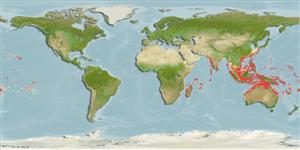
Indo-Pacific: Red Sea south to Natal, South Africa and east to the Marquesas and Tuamoto islands, north to southern Japan, south to the southern Great Barrier Reef and New Caledonia.
Tamanho / Peso / Idade
Maturidade: Lm ? range ? - ? cm
Max length : 50.0 cm TL macho/indeterminado; (Ref. 3145); idade máx. registrada: 23 anos (Ref. 52229)
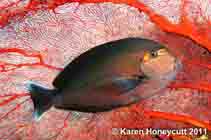
Espinhos dorsais (total) : 9; Raios dorsais (total) : 24 - 26; Espinhos anais: 3; Raios anais : 23 - 24. This species is distinguished by the following characters: body moderately deep and compressed, its depth 2.1-2.5 times in standard length or SL (smaller individuals are deeper-bodied); snout relatively short, 6-6.9 times in SL; eye 3.2-4.5 times in head length (at 12-28 cm SL); mouth small; teeth spatulate, close-set, with denticulate edges, and small for the genus; total gill rakers on first gill arch 13-15; continuous, unnotched dorsal fin IX,24-26; A III,23-24; caudal fin emarginate to lunate, concavity 6.5-9 times in SL (concavity is greater in larger individuals); caudal peduncle narrow, the least depth 10-12 times in SL with a lancet-like spine on each side which folds into a deep horizontal groove; stomach large, U-shaped, thin-walled with large, thorn-like papillae on inner surface; colour brown with longitudinal blue lines on head and body; a yellow area behind eye and 2 yellow bands extending anteriorly from eye; when alive, this fish is capable of changing its ground colour from dark brown to pale blue (Ref. 9808).
Body shape (shape guide): short and / or deep; Cross section: compressed.
Adults inhabit steep slopes, often in turbid waters, generally in the vicinity of coral reefs (Ref. 58652) or rocky bottoms. They form resident spawning aggregations (Ref. 27825, 48637). Adults often seen in schools, feeding mid-water on plankton (Ref. 48637). Feed on zooplankton. Marketed fresh. Flesh is almost never poisonous (Ref. 4795), but incidence of ciguatera poisoning was reported from Nauru I. (Ref. 125620). The retractile sharp blades of the caudal peduncle can be dangerous (https://www.monaconatureencyclopedia.com/acanthurus-mata-2/?lang=en, ver. 12/2021)
Ciclo de vida ou comportamento de acasalamento
Maturidade | Reprodução | Desova | Ovos | Fecundidade | Larvas
Form resident spawning aggregations (Ref. 27825).
Randall, J.E., 1987. Three nomenclatorial changes in Indo-Pacific surgeonfishes (Acanthurinae). Pac. Sci. 41(1-4):54-61. (Ref. 1921)
Status na Lista Vermelha da UICN (Ref. 130435: Version 2025-2 (Global))
Ameaça para os humanos
Traumatogenic (Ref. 4716)
Uso pelos humanos
Pescarias: espécies comerciais; Aquário: Espécies comerciais
Ferramentas
Relatórios especiais
Baixar XML
Fontes da internet
Estimativas baseadas em modelos
Temperatura preferida (Ref.
123201): 24.7 - 29, mean 27.9 °C (based on 1918 cells).
Índice de diversidade filogenética (Ref.
82804): PD
50 = 0.5000 [Uniqueness, from 0.5 = low to 2.0 = high].
Bayesian length-weight: a=0.02570 (0.01733 - 0.03813), b=2.92 (2.80 - 3.04), in cm total length, based on LWR estimates for this species & Genus-body shape (Ref.
93245).
Nível Trófico (Ref.
69278): 2.5 ±0.25 se; based on food items.
Generation time: 5.0 ( na - na) years. Estimated as median ln(3)/K based on 1
growth studies.
Resiliência (Ref.
120179): Baixo, tempo mínimo de duplicação da população 4,5 - 14 anos (K=0.219; tmax=23).
Vulnerabilidade da pesca (Ref.
59153): Moderate vulnerability (39 of 100).
🛈
Nutrientes (Ref.
124155): Calcium = 38.8 [15.8, 103.9] mg/100g; Iron = 0.604 [0.236, 1.442] mg/100g; Protein = 18.3 [17.1, 19.5] %; Omega3 = 0.107 [0.050, 0.221] g/100g; Selenium = 22.2 [8.0, 61.9] μg/100g; VitaminA = 40.8 [10.3, 147.2] μg/100g; Zinc = 2.28 [0.72, 4.04] mg/100g (wet weight); based on
nutrient studies.