Klassifizierung / Names
Namen | Synonyme | Catalog of Fishes(Gattung, Arten) | ITIS | CoL | WoRMS | Cloffa
Elasmobranchii (Haie und Rochen) (sharks and rays) >
Rajiformes (Skates and rays) >
Rajidae (Skates)
Etymology: Rostroraja: Latin, rostrum = beak + Latin, raja, -ae = a sting ray (Ref. 45335).
Umwelt: Milieu / Klimazone / Tiefenbereich / Verbreitungsgebiet
Ökologie
seewasser demersal; tiefenbereich 1 - 183 m (Ref. 117734), usually 15 - 110 m (Ref. 37039). Subtropical; 14°C - 28°C (Ref. 26938); 30°N - 18°N, 98°W - 80°W
Western Central Atlantic: Florida, USA and the Gulf of Mexico.
Länge bei der ersten Reifung / Größe / Gewicht / Alter
Geschlechtsreife: Lm 53.7, range 48 - 56 cm
Max length : 53.0 cm WD Männchen/unbestimmt; (Ref. 7251); max. veröff. Alter: 9 Jahre (Ref. 117734)
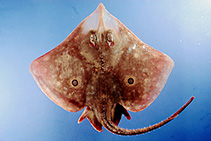
Disk diamond-shaped; round dark spot surrounded by pale ring on base of each pectoral fin. (Ref. 26938). No small pale or dark spots on upper surface of disk, but sometimes dark blotches. No scapular spines, 1 middorsal row of spines. Distance from ocellus to eye usually less than or about equal to distance between ocelli. Snout with a clear area on each side (Ref. 7251). Upper surface rich chocolate or coffee brown, translucent on either side fo rostral cartilage. Lower surface plain white (Ref. 6902).
Body shape (shape guide): other.
Occur from near shore to 183 m depth at temperatures ranging from 14 to 28° C but it is most common inshore of 91 m at 16-25°C. Young occur in shallow bays. Adults tend to live offshore (Ref. 26938). Adults feed mainly on decapod crustaceans and to a lesser extent on other benthic invertebrates and fishes. Oviparous. Distinct pairing with embrace. Young may tend to follow large objects, such as their mother (Ref. 205). Eggs are oblong capsules with stiff pointed horns at the corners deposited in sandy or muddy flats (Ref. 205). Egg capsules are 6.3 cm long and 3.8 cm wide (Ref. 41359).
Lebenszyklus und Paarungsverhalten
Geschlechtsreife | Fortpflanzung | Ablaichen | Eier | Fruchtbarkeit | Larven
Oviparous, paired eggs are laid. Embryos feed solely on yolk (Ref. 50449). Distinct pairing with embrace. oung may tend to follow large objects, such as their mother (Ref. 205).
McEachran, J.D. and K.A. Dunn, 1998. Phylogenetic analysis of skates, a morphologically conservative clade of elasmobranchs (Chondrichthyes: Rajidae). Copeia 1998(2):271-290. (Ref. 27314)
IUCN Rote Liste Status (Ref. 130435: Version 2025-2 (Global))
Bedrohung für Menschen
Harmless
Nutzung durch Menschen
Fischereien: weniger kommerziell; Köder: occasionally
Tools
Zusatzinformationen
Download XML
Internet Quellen
Schätzungen auf der Grundlage von Modellen
Bevorzugte Temperatur (Ref.
123201): 21.2 - 27.5, mean 24.9 °C (based on 230 cells).
Phylogenetischer Diversitätsindex (Ref.
82804): PD
50 = 0.5039 [Uniqueness, from 0.5 = low to 2.0 = high].
Bayesian length-weight: a=0.00302 (0.00141 - 0.00645), b=3.24 (3.07 - 3.41), in cm total length, based on LWR estimates for this (Sub)family-body shape (Ref.
93245).
Trophische Ebene (Ref.
69278): 3.8 ±0.58 se; based on food items.
Generation time: 4.8 ( na - na) years. Estimated as median ln(3)/K based on 2
growth studies.
Widerstandsfähigkeit (Ref.
120179): niedrig, Verdopplung der Population dauert 4,5 - 14 Jahre. (k = 0.29; tmax = 9; tm = 5; Fec assumed to be <100).
Anfälligkeit der Fischerei (Ref.
59153): Moderate to high vulnerability (45 of 100).
🛈