sub class Elasmobranchii (ฉลามและกระเบน) (sharks and rays) >
Myliobatiformes (Stingrays) >
Myliobatidae (Eagle and manta rays)
Etymology: Myliobatis: Greek, mylo = mill + Greek, + Greek, batis,-idos = a ray (Raja sp.) (Ref. 45335).
Eponymy: Christophe/Chrétien-Paulin de la Poix Chevalier de Fréminville (1787–1848) was a French naval officer and naturalist. [...] (Ref. 128868), visit book page.
More on author: Lesueur.
สิ่งแวดล้อม : สิ่งแวดล้อม / เขตภูมิอากาศ / ระดับความลึก / ระยะการกระจายสินค้า
นิเวศวิทยา
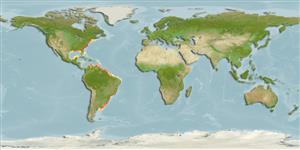
เกี่ยวกับทะเล,น้ำเค็ม; กร่อย กลุ่มสัตว์หน้าดิน,กลุ่มสัตว์พื้นท้องน้ำ; ระดับความลึก 0 - 100 m (Ref. 57911), usually 1 - 10 m. Subtropical; 43°N - 42°S, 97°W - 33°W
Western Atlantic: continental waters from Cape Cod to southeastern Florida (?) in the USA; also southern Brazil to Argentina (Ref. 58839). Reported (but not known for certain) from Gulf of Mexico, Florida and Caribbean islands, and northern South America. Often confused with Myliobatis goodei (Ref. 3173).
ความยาวเมื่อครบกำหนดครั้งแรก / ขนาด / น้ำหนัก / อายุ
วัยเจริญพันธุ์: Lm 65.0, range 60 - 70 cm
Max length : 129 cm WD เพศผู้/กระเทย; (Ref. 49746); common length : 70.0 cm WD เพศผู้/กระเทย; (Ref. 5217)
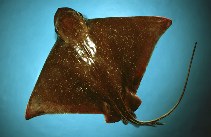
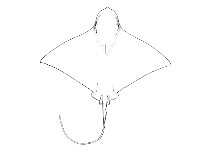
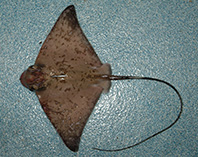
Disk broad with long sharply pointed wings and projecting snout. Tail very long, Few middorsal spines on disk in adults (Ref. 7251). Greyish, reddish chocolate or dusky brown above. Lower surface either pure white or whitish. Teeth green (Ref. 6902).
Body shape (shape guide): other.
Found frequently in coastal waters to 10 m depth, mainly in shallow estuaries. Capable of traveling long distances, occasionally leaps out of the water. Swims in midwater. Cruises slowly over the bottom, rooting out bivalves with its beak and wings when feeding (Ref. 7251). Ovoviviparous (Ref. 50449).
Exhibit ovoviparity (aplacental viviparity), with embryos feeding initially on yolk, then receiving additional nourishment from the mother by indirect absorption of uterine fluid enriched with mucus, fat or protein through specialised structures (Ref. 50449).
Robins, C.R. and G.C. Ray, 1986. A field guide to Atlantic coast fishes of North America. Houghton Mifflin Company, Boston, U.S.A. 354 p. (Ref. 7251)
สถานะบัญชีแดงของ IUCN (Ref. 130435: Version 2025-2 (Global))
ภัยคุกคามต่อมนุษย์
Harmless
การใช้ของมนุษย์
การประมง: มีการค้าเพียงเล็กน้อย
เครื่องมือ
รายงานพิเศษ
ดาวน์โหลด XML
แหล่งที่มาจากอินเตอร์เน็ต
การประมาณค่าตามแบบจำลอง
อุณหภูมิที่ต้องการ (อ้างอิง
123201): 14.2 - 28.1, mean 24.2 °C (based on 594 cells).
ดัชนีความหลากหลายทางวิวัฒนาการ (อ้างอิง
82804): PD
50 = 0.5002 [Uniqueness, from 0.5 = low to 2.0 = high].
Bayesian length-weight: a=0.00389 (0.00124 - 0.01219), b=3.08 (2.83 - 3.33), in cm total length, based on LWR estimates for this (Sub)family-body shape (Ref.
93245).
ระดับชั้นอาหาร (อ้างอิง
69278): 3.4 ±0.0 se; based on diet studies.
ความสามารถในการกลับคืนสู่ปกติ (อ้างอิง
120179): ต่ำมาก, เวลาต่ำสุดที่จะทำให้ประชากรเพิ่มขึ้นเป็น 2 เท่าใช้เวลามากกว่า 14 ปี (Fec=4-8).
ความเสี่ยงต่อการตกปลา (Ref.
59153): Very high vulnerability (83 of 100).
🛈
สารอาหาร (Ref.
124155): Calcium = 17.7 [3.0, 78.8] mg/100g; Iron = 0.619 [0.159, 1.673] mg/100g; Protein = 21.5 [16.5, 26.6] %; Omega3 = 0.259 [0.074, 0.765] g/100g; Selenium = 23.1 [6.7, 60.5] μg/100g; VitaminA = 10.5 [4.4, 24.4] μg/100g; Zinc = 0.737 [0.363, 1.334] mg/100g (wet weight);