Entorno: milieu / zona climática / rango de profundidad / gama de distribución
Ecología
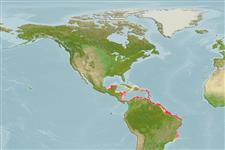
marino demersal; rango de profundidad 1 - 36 m (Ref. 13608). Tropical; 22°N - 24°S, 97°W - 30°W
Western Atlantic: southern Gulf of Mexico and West Indies to Santos, Brazil.
Longitud en la primera madurez / Tamaño / Peso / Edad
Madurez: Lm 58.8, range 50 - 55 cm
Max length : 200 cm WD macho / no sexado; (Ref. 3168); common length : 125 cm WD macho / no sexado; (Ref. 6077)
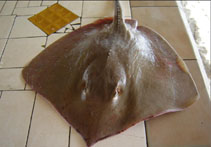
Disc rhomboid. Blunt and close-set tubercles that clothe the midzone of disc. Snout in front of eyes about 1.4 times as long as distance between outer margins of orbits. Upper surface brown, sometimes yellowish or olivaceous. Lower surface pure or yellowish white, ventral tail fold and dorsal keel black (Ref. 6902).
Body shape (shape guide): other.
Demersal species on continental shelf to at least 35 m (but likely to be deeper); also found in brackish water, with young collected from tide pools (Ref. 114953). Mobile invertebrate feeders, feeds on benthic mobile invertebrates such as molluscs, crustaceans and worms associated with hard or nearby unconsolidated substrate (Ref. 103985); also on small fishes (Ref. 114953). Ovoviviparous (Ref. 50449). Marketed salted; also used in the preparation of gelatin and good quality oil. Between 1995 and 2000, at least 5 specimens have been traded as aquarium fish at Ceará, Brazil (Ref. 49392).
Exhibit ovoviparity (aplacental viviparity), with embryos feeding initially on yolk, then receiving additional nourishment from the mother by indirect absorption of uterine fluid enriched with mucus, fat or protein through specialised structures (Ref. 50449). Distinct pairing with embrace (Ref. 205).
Last, P.R., W.T. White, M.R. de Carvalho, B. Séret, M.F.W. Stehmann and G.J.P. Naylor, 2016. Rays of the world. CSIRO Publishing, Comstock Publishing Associates. i-ix + 1-790. (Ref. 114953)
Situación en la Lista Roja de la UICN (Ref. 130435: Version 2025-2 (Global))
Amenaza para el ser humano
Traumatogenic (Ref. 3168)
Usos humanos
Pesquerías: escaso valor comercial
Herramientas
Informes especiales
Descargar XML
Fuentes de Internet
Estimaciones basadas en modelos
Temperatura preferida (Referencia
123201): 26.7 - 28.2, mean 27.6 °C (based on 565 cells).
Índice de diversidad filogenética (Referencia
82804): PD
50 = 0.5010 [Uniqueness, from 0.5 = low to 2.0 = high].
Bayesian length-weight: a=0.00692 (0.00342 - 0.01399), b=3.13 (2.95 - 3.31), in cm total length, based on LWR estimates for this species & (Sub)family-body (Ref.
93245).
Nivel trófico (Referencia
69278): 4.3 ±0.3 se; based on diet studies.
Resiliencia (Referencia
120179): Muy bajo, población duplicada en un tiempo mínimo superior a 14 años (Fec=2).
Vulnerabilidad pesquera (Ref.
59153): Very high vulnerability (90 of 100).
🛈