Milieu: milieu / Klimaatzone / Diepte / verspreidingsgebied
Ecologie
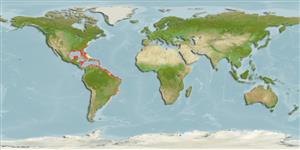
marien; brak water rifbewoner; diepte ? - 48 m (Ref. 9710). Subtropical; 42°N - 35°S, 98°W - 34°W
Western Atlantic to Southwest Atlantic: Rhode Island, USA to southeastern Brazil.
Lengte bij maturiteit / Grootte / Gewicht / Leeftijd
Maturiteit: Lm 10.8 range ? - ? cm
Max length : 38.8 cm TL mannelijk / geslacht onbekend; (Ref. 26340); common length : 20.0 cm TL mannelijk / geslacht onbekend; (Ref. 3821); max. gepubliceerd gewicht: 400.00 g (Ref. 5217)
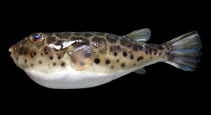
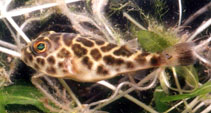
Dorsale stekels (totaal) : 0; Dorsale zachte stralen (totaal) : 11 - 12; Anale stekels: 0; Anale zachte stralen: 11. Greenish above, pale yellow to white below; back has series of pale lines and arcs suggesting concentric circles with intersecting lines. No other puffer has this color pattern (Ref. 26938).
Body shape (shape guide): fusiform / normal.
Commonly found in bays, tidal creeks and protected coastal waters, especially on seagrass beds, and in brackish water. Rare or absent on coral reefs. Does not form schools, but may form huge aggregates. Hides in the sand when frightened (Ref. 9710). Feeds mainly on bivalves, gastropods, foraminiferans and several other benthic invertebrates specially crustaceans, which it crushes with its powerful teeth (Ref. 35237). To ward off predators, it inflates itself like a balloon. Highly toxic; used to poison cats and dogs (Ref. 2861).
Spawning season is from late spring to early fall at Biscayne Bay, Florida. Mean length at first maturity is over 13 cm TL.
Robins, C.R. and G.C. Ray, 1986. A field guide to Atlantic coast fishes of North America. Houghton Mifflin Company, Boston, U.S.A. 354 p. (Ref. 7251)
Status op de Rode Lijst van het IUCN (Ref. 130435: Version 2025-2 (Global))
Gevaar voor de mens
Poisonous to eat (Ref. 3821)
Gebruik door de mens
Visserij: van geen belang
Tools
Speciale rapporten
Download XML
Internetbronnen
Schattingen op basis van modellen
Gewenste temperatuur (Ref.
123201): 22.9 - 28, mean 25.6 °C (based on 472 cells).
Fylogenetische diversiteitsindex (Ref.
82804): PD
50 = 0.5000 [Uniqueness, from 0.5 = low to 2.0 = high].
Bayesian length-weight: a=0.02042 (0.01701 - 0.02451), b=2.94 (2.89 - 2.99), in cm total length, based on LWR estimates for this species (Ref.
93245).
Trofisch niveau (Ref.
69278): 3.4 ±0.41 se; based on food items.
Generation time: 2.2 ( na - na) years. Estimated as median ln(3)/K based on 2
growth studies.
Weerstandsvermogen (Ref.
120179): laag, minimale populatieverdubbelingstijd 4,5-14 jaar (K=0.51; rel. fec=1.146 eggs/ g body weight).
Kwetsbaarheid van de visserij (Ref.
59153): Low vulnerability (22 of 100).
🛈
Voedingsstoffen (Ref.
124155): Calcium = 32.1 [11.0, 104.4] mg/100g; Iron = 0.721 [0.352, 1.490] mg/100g; Protein = 19.9 [17.7, 22.1] %; Omega3 = 0.248 [0.115, 0.488] g/100g; Selenium = 17.2 [7.6, 39.1] μg/100g; VitaminA = 29.4 [8.7, 102.1] μg/100g; Zinc = 0.919 [0.596, 1.423] mg/100g (wet weight);