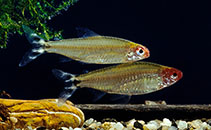
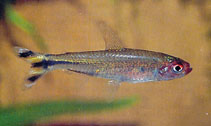
Classification / Noms
Noms communs | Synonymes | Catalog of Fishes(Genre, Espèce) | ITIS | CoL | WoRMS | Cloffa
>
Characiformes (Characins) >
Acestrorhamphidae (American tetras) > Megalamphodinae
Etymology: Petitella: French, petit = small, diminituve (Ref. 45335).
Eponymy: Professor Georges Jean-Jacques Petit (1892–1973) was a French marine biologist at the Muséum National d’Histoire Naturelle. [...] (Ref. 128868), visit book page.
More on author: Ahl.
Taxonomic Remarks
Ornamental fish. See Géry & Uj (1986) and Taphorn (1992: 224-225) for taxonomic remarks.
Environnement : milieu / zone climatique / profondeur / gamme de distribution
Écologie
; eau douce benthopélagique. Tropical
South America: lower Amazon River basin and Orinoco River basin.
Taille / Poids / Âge
Maturité: Lm ? range ? - ? cm
Max length : 5.0 cm TL mâle / non sexé; (Ref. 38376)
Description synthétique
Clés d'identification | Morphologie | Morphométrie
This species is distinguished from its congeners by the folowing charactes: head with red color not extending to the humeral region and with a black spot on the lower posterior border of the caudal peduncle (vs. head color not extending to humeral region with only one black spot on caudal peduncle in georgiae, and head color extending to humeral with two black spots on caudal peduncle in bleheri); dentary with 5-6 teeth, with 5 cuspids, usually followed by 4 conical ones (vs. 9-11 teeth, with 5 cuspids in georgiae, and 6 teeth, with 6-7 cuspids, followed by 1 or 2 tricuspidate ones in bleheri) (Ref. 127081).
Cross section: compressed.
Aquarium keeping: in groups of 5 or more individuals; minimum aquarium size 80 cm (Ref. 51539).
Cycle de vie et comportement reproducteur
Maturité | Reproduction | Frai | Œufs | Fécondité | Larves
Lima, F.C.T., L.R. Malabarba, P.A. Buckup, J.F. Pezzi da Silva, R.P. Vari, A. Harold, R. Benine, O.T. Oyakawa, C.S. Pavanelli, N.A. Menezes, C.A.S. Lucena, M.C.S.L. Malabarba, Z.M.S. Lucena, R.E. Reis, F. Langeani, C. Moreira et al. …, 2003. Genera Incertae Sedis in Characidae. p. 106-168. In R.E. Reis, S.O. Kullander and C.J. Ferraris, Jr. (eds.) Checklist of the Freshwater Fishes of South and Central America. Porto Alegre: EDIPUCRS, Brasil. (Ref. 38376)
Statut dans la liste rouge de l'IUCN (Ref. 130435: Version 2025-2 (Global))
Menace pour l'homme
Harmless
Utilisations par l'homme
Pêcheries: commercial; Aquarium: Commercial
Outils
Articles particuliers
Télécharger en XML
Sources Internet
Estimations basées sur des modèles
Indice de diversité phylogénétique (Réf.
82804): PD
50 = 0.6250 [Uniqueness, from 0.5 = low to 2.0 = high].
Bayesian length-weight: a=0.00389 (0.00180 - 0.00842), b=3.12 (2.94 - 3.30), in cm total length, based on all LWR estimates for this body shape (Ref.
93245).
Niveau trophique (Réf.
69278): 3.1 ±0.4 se; based on size and trophs of closest relatives
Résilience (Réf.
120179): Haut, temps minimum de doublement de population inférieur à 15 mois (Preliminary K or Fecundity.).
Vulnérabilité de la pêche (Ref.
59153): Low vulnerability (10 of 100).
🛈