>
Cichliformes (Cichlids, convict blennies) >
Cichlidae (Cichlids) > Cichlasomatinae
Etymology: Hypsophrys: Greek, hypsi = high + Greek, ophrys = eyebrow (Ref. 45335).
More on author: Günther.
Taxonomic Remarks
Species monograph by López (1974), well illustrated. Kullander & Hartel (1997) discussed the nomenclature of Hypsophrys unimaculatus. Reviewed by Bussing (1998: 354), with key, diagnosis, geographical distribution, and figures.
Lingkungan: lingkungan / zona iklim / kisaran kedalaman / jangkauan distribusi
Ekologi
; air tawar bentopelagis; pH range: 7.0 - 8.0; dH range: 9 - 20. Tropical; 23°C - 36°C (Ref. 36880)
Central America: Atlantic slope, from the San Juan drainage, including Lake Nicaragua, in Costa Rica and Nicaragua, to the Matina River drainage in Costa Rica.
Ukuran / Berat / umur
Kematangan: Lm ? range ? - ? cm
Max length : 16.5 cm SL jantan/; (Ref. 36377); 20.0 cm TL (female)
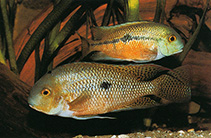
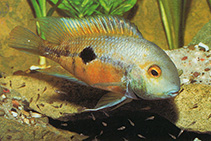
Duri punggung (Keseluruhan (total)) : 18 - 19; duri punggung lunak (Keseluruhan (total)) : 9 - 11; Duri dubur: 7 - 8; Sirip dubur lunak: 7 - 9. This species can be distinguished by the dark line running through the middle of the body and the large black blotch positioned midlength; head profile extremely curved with the mouth on the lower part of the head; in males, the scales have dark edges producing a reticulated pattern, their fins with many dark spots, and a red edge to the dorsal fin; both males with iridescent, greenish-blue head and with gold to copper-colored bodies (Ref. 44091).
Body shape (shape guide): fusiform / normal; Cross section: compressed.
Inhabit lakes and rivers with slow to moderate currents, between 5 to 200 m elevation (Ref. 36880). Juveniles feed on aquatic insects, while adults feed on bottom detritus, seeds and leaves. Also naturally feed on snails and other mollusks, but will accept a variety of food in captivity (Ref. 44091). Maximum length 25 cm TL (Ref. 2060).
Deposits eggs in sand depressions. Produces about 200-400 non adhesive eggs with females practicing communal care during the post spawning period (an unusual behavior referred to as "creching", Ref. 44091). A group of 3 or 4 females stand guard over their combined spawns, encircling the expanded group and do not allow any intruders or predators into the rearing arena.
Kullander, S.O., 2003. Cichlidae (Cichlids). p. 605-654. In R.E. Reis, S.O. Kullander and C.J. Ferraris, Jr. (eds.) Checklist of the Freshwater Fishes of South and Central America. Porto Alegre: EDIPUCRS, Brasil. (Ref. 36377)
Status IUCN Red List (Ref. 130435: Version 2025-2 (Global))
ancaman kepada manusia
Harmless
penggunaan manusia
Perikanan: tidak ada kepentingan; Akuarium: Komersial
Alat, peralatan
laporan khas
muat turun XML
Sumber internet
Estimasi berdasarkan model
Indeks keanekaragaman filogenetik (Acuan
82804): PD
50 = 0.7500 [Uniqueness, from 0.5 = low to 2.0 = high].
Bayesian length-weight: a=0.02188 (0.01025 - 0.04670), b=3.05 (2.87 - 3.23), in cm total length, based on LWR estimates for this (Sub)family-body shape (Ref.
93245).
Tingkat Trofik (Acuan
69278): 2.7 ±0.34 se; based on food items.
Daya lenting (Acuan
120179): Tinggi, Waktu penggandaan populasi minimum kurang dari 15 bulan (Preliminary K or Fecundity.).
Kerentanan Penangkapan Ikan (Ref.
59153): Low vulnerability (10 of 100).
🛈