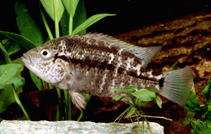
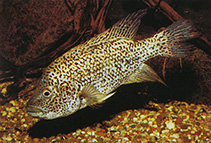
Environnement : milieu / zone climatique / profondeur / gamme de distribution
Écologie
; eau douce; saumâtre benthopélagique. Tropical; 24°C - 27°C (Ref. 13614)
Central America: Hispaniola (Haiti and Dominican Republic).
Longueur à la première maturité / Taille / Poids / Âge
Maturité: Lm ?, range 8 - ? cm
Max length : 21.5 cm SL mâle / non sexé; (Ref. 36377)
Inhabits lakes and streams. Largely found solitarily or in pairs, rarely in groups of 6-8, often in association with poeciliids and the mugilid Agonostomus monticola. Occurs with introduced cichlids at numerous localities. Adults swim in open water, taking refuge in small crevices under debris or in rocks when pursued. Young fish are frequently found in aquatic vegetation. Feeds on algae, other aquatic plants and turret shells.
Cycle de vie et comportement reproducteur
Maturité | Reproduction | Frai | Œufs | Fécondité | Larves
Clean a stone and deposit 150-200 eggs. Female cares for eggs and larvae (Ref. 40602).
Chakrabarty, P., 2006. Taxonomic status of the Hispaniolan Cichlidae. Occasional Papers of the Museum of Zoology University of Michigan No. 737:1-17. (Ref. 79681)
Statut dans la liste rouge de l'IUCN (Ref. 130435: Version 2025-2 (Global))
Menace pour l'homme
Harmless
Utilisations par l'homme
Pêcheries: commercial; Aquarium: Commercial
Outils
Articles particuliers
Télécharger en XML
Sources Internet
Estimations basées sur des modèles
Indice de diversité phylogénétique (Réf.
82804): PD
50 = 0.6250 [Uniqueness, from 0.5 = low to 2.0 = high].
Bayesian length-weight: a=0.02692 (0.01211 - 0.05983), b=3.02 (2.83 - 3.21), in cm total length, based on LWR estimates for this (Sub)family-body shape (Ref.
93245).
Niveau trophique (Réf.
69278): 2.9 ±0.35 se; based on food items.
Résilience (Réf.
120179): Haut, temps minimum de doublement de population inférieur à 15 mois (Preliminary K or Fecundity.).
Vulnérabilité de la pêche (Ref.
59153): Low vulnerability (16 of 100).
🛈