>
Acanthuriformes (Surgeonfishes) >
Chaetodontidae (Butterflyfishes)
Etymology: Johnrandallia: After John Randall, marine biologist, Bishop Museum of Hawaii; he worked in systematic ichthyology with fishes of Indopacific region.
Eponymy: John Randall, marine biologist at the Bishop Museum, Hawaii. (See Randall, also see Helen (Randall)) (Ref. 128868), visit book page.
More on author: Gill.
Miljö: miljö / Klimatzon / djupintervall / distributionsområde
Ekologi
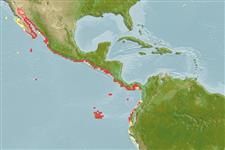
marina revassocierade; djupintervall 6 - 40 m (Ref. 9286), usually 6 - 12 m (Ref. 9286). Tropical; 40°N - 10°S, 120°W - 70°W
Eastern Pacific: Gulf of California to Panama, including the Cocos, Malpelo and Galapagos Islands.
Storlek / Vikt / Ålder
Könsmognad: Lm ? range ? - ? cm
Max length : 20.0 cm TL hane/ej könsbestämd; (Ref. 9286); common length : 14.0 cm TL hane/ej könsbestämd; (Ref. 55763)
Kort beskrivning
Bestämningsnycklar | Morfologi | Morfometri
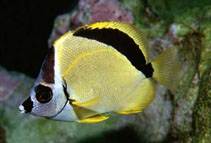
Taggstrålar i ryggfenan (totalt) : 11 - 12; Mjukstrålar i ryggfenan (totalt) : 24 - 25; Taggstrålar i analfenan: 3; Mjukstrålar i analfenan: 18 - 20. Body deep, compressed, and disk-shaped; dorsal profile of head steep and concave; snout pronounced; teeth very small and se in a comb-like band; base of pelvic spine with an axillary process; lateral line complete, extending over caudal peduncle; body yellowish; snout with a dark stain; eye bordered with black; posterior edge of operculum, base of pectoral fins, nape, and dorsal border (at base of dorsal fin) black (Ref. 55763).
Body shape (shape guide): short and / or deep; Cross section: compressed.
Often in large schools (Ref. 5227) over coral and rocky reefs (Ref. 9286). Feed on algae, gastropods, and small crustaceans (Ref. 9286). Pick parasites from larger fishes like Paranthias colonus and Mulloides dentatus (Ref. 28023). Oviparous (Ref. 205). Form pairs during breeding (Ref. 205).
Livscykel och parningsbeteende
Könsmognad | Reproduktion | Lek | Ägg | Fekunditet | Larver
Form pairs during breeding (Ref. 205).
Schneider, M., 1995. Chaetodontidae. Peces mariposa. p. 1000-1003. In W. Fischer, F. Krupp, W. Schneider, C. Sommer, K.E. Carpenter and V. Niem (eds.) Guia FAO para Identification de Especies para lo Fines de la Pesca. Pacifico Centro-Oriental. 3 Vols. FAO, Rome. (Ref. 9286)
Status på IUCN:s rödlista (Ref. 130435: Version 2025-2 (Global))
Hot mot människor
Harmless
Mänskliga användningsområden
Fiskeri: kommersiell; Akvarium: Kommersiell
Verktyg
Särskilda rapporter
Ladda ner XML
Internet-källor
Uppskattningar baserade på modeller
Önskad temperatur (Ref.
123201): 17.9 - 29, mean 26.6 °C (based on 144 cells).
Index för fylogenetisk mångfald (Ref.
82804): PD
50 = 1.0000 [Uniqueness, from 0.5 = low to 2.0 = high].
Bayesian length-weight: a=0.02818 (0.01692 - 0.04693), b=3.07 (2.92 - 3.22), in cm total length, based on LWR estimates for this species & (Sub)family-body (Ref.
93245).
Trofisk nivå (Ref.
69278): 3.0 ±0.44 se; based on food items.
Resiliens (Ref.
120179): Hög, lägsta populationsfördubblingstid mindre än 15 månader (Preliminary K or Fecundity.).
Sårbarhet i fisket (Ref.
59153): Low vulnerability (10 of 100).
🛈
Näringsämnen (Ref.
124155): Calcium = 89.4 [47.0, 136.0] mg/100g; Iron = 0.773 [0.468, 1.239] mg/100g; Protein = 18.6 [17.4, 19.6] %; Omega3 = 0.114 [0.071, 0.177] g/100g; Selenium = 34.1 [19.7, 61.6] μg/100g; VitaminA = 46.2 [13.5, 153.7] μg/100g; Zinc = 1.4 [1.0, 2.0] mg/100g (wet weight);