>
Cypriniformes (Carps) >
Botiidae (Pointface loaches) > Botiinae
Eponymy: Professor Lieven Ferdinand de Beaufort (1879–1968) was a Dutch zoologist whose main interests were first fish and then birds. [...] (Ref. 128868), visit book page.
More on author: Smith.
Environnement : milieu / zone climatique / profondeur / gamme de distribution
Écologie
; eau douce démersal; pH range: 6.0 - 6.5; dH range: ? - 5. Tropical; 24°C - 28°C (Ref. 2060)
Asia: Mekong, Chao Phraya and Meklong basins; northern Malay Peninsula.
Taille / Poids / Âge
Maturité: Lm ? range ? - ? cm
Max length : 25.0 cm SL mâle / non sexé; (Ref. 30857)
Description synthétique
Clés d'identification | Morphologie | Morphométrie
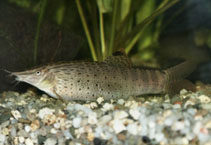
Has 9-12 faint vertical bars with superimposed longitudinal rows of spots of different sizes; several longitudinal stripes on the head and the upper anterior part of the body; a black margin and 3 longitudinal rows of spots on the dorsal fin; several vertical rows of spots on the caudal fin (Ref. 27732); 9 branched dorsal-fin rays; erect ethmoid spine never perpendicular to snout when viewed from above; small mental lobe, lower lip without papillae (Ref. 12693).
Body shape (shape guide): elongated.
Usually associated with clear water, swift current and stony to rocky substrate (Ref. 27732). Found in small and medium-sized rivers. Borrows in sand or digs holes under rocks. Enters the flooded forest during the high-water periods and returns to the rivers during November and December in the lower Mekong. Feeds on mollusks and crustaceans. Intolerant of nitrates, it rapidly disappears from areas where fertilizers are applied to crops. Occasionally seen in fish markets (Ref. 12693).
Cycle de vie et comportement reproducteur
Maturité | Reproduction | Frai | Œufs | Fécondité | Larves
Kottelat, M., 2004. Botia kubotai, a new species of loach (Teleostei: Cobitidae) from the Ataran River basin (Myanmar), with comments on botiine nomenclature and diagnosis of a new genus. Zootaxa 401:1-18. (Ref. 50472)
Statut dans la liste rouge de l'IUCN (Ref. 130435: Version 2025-2 (Global))
Menace pour l'homme
Harmless
Utilisations par l'homme
Pêcheries: intérêt commercial mineur; Aquarium: Commercial
Outils
Articles particuliers
Télécharger en XML
Sources Internet
Estimations basées sur des modèles
Indice de diversité phylogénétique (Réf.
82804): PD
50 = 0.5312 [Uniqueness, from 0.5 = low to 2.0 = high].
Bayesian length-weight: a=0.00589 (0.00250 - 0.01388), b=3.08 (2.88 - 3.28), in cm total length, based on LWR estimates for this (Sub)family-body shape (Ref.
93245).
Niveau trophique (Réf.
69278): 3.5 ±0.50 se; based on food items.
Vulnérabilité de la pêche (Ref.
59153): Low vulnerability (21 of 100).
🛈