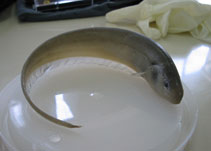
Milieu: milieu / Klimaatzone / Diepte / verspreidingsgebied
Ecologie
; zoet water benthopelagisch; pH range: 6.0 - 6.5; dH range: 4 - 15. Tropical; 22°C - 28°C (Ref. 2059)
South America: Magdalena River basin; entire extent of the Amazon and Orinoco River basins below approximately 500 m elevation including Napo River of western Ecuador and Madre de Dios River of Peru; all drainages of the Guianas Shield; Atlantic drainages of northeastern Brazil (Tocantins, Parnaíba, Pindaré, Itapicuru, and Salgado rivers); São Francisco River basin; Rio de Janeiro, Brazil; Paraguay-Paraná River basin.
Lengte bij maturiteit / Grootte / Gewicht / Leeftijd
Maturiteit: Lm 25.0, range 20 - 30 cm
Max length : 141 cm TL mannelijk / geslacht onbekend; (Ref. 39524)
Korte beschrijving
Determinatiesleutels | Morfologie | Morfometrie
Anale zachte stralen: 195 - 300.
Body shape (shape guide): elongated.
Occurs in swamps, creeks, and river with lentic waters. Preys on small invertebrates, particularly the larvae of aquatic insects (Ref. 12225). Breeds before the start of the rainy season (Ref. 10645) or during the rainy season, with a fecundity count of 6473 eggs (Ref. 10643). Males persistently defend their territory and apparently make electric signals (by increased electric organ discharge (EOD) rates and interruptions thereof) to females passing by to draw in a spawning partner (Ref. 10605). Mature females' EODs are of higher frequencies than mature males (Ref. 10645). Plasma androgens modulate the EOD frequency during the breeding season (Ref. 10767). Embryos hatch on day 4; larvae begin to feed on day 11. The electric organ and electroreceptors are both present in the larva at the time of first exogenous feeding (Ref. 10605). Seems to reach sexual maturity at 1 year of age, based on breeding experiments (Ref. 10011).
Eggs of 3 mm diameter are deposited among plants. Larvae hatch after 4 days and start feeding after 11 days.
Ortega, H. and R.P. Vari, 1986. Annotated checklist of the freshwater fishes of Peru. Smithson. Contrib. Zool. (437):1-25. (Ref. 6329)
Status op de Rode Lijst van het IUCN (Ref. 130435: Version 2025-2 (Global))
Gevaar voor de mens
Harmless
Gebruik door de mens
Visserij: commercieel; Aquarium: Commercieel
Tools
Speciale rapporten
Download XML
Internetbronnen
Schattingen op basis van modellen
Fylogenetische diversiteitsindex (Ref.
82804): PD
50 = 0.5010 [Uniqueness, from 0.5 = low to 2.0 = high].
Bayesian length-weight: a=0.00309 (0.00180 - 0.00531), b=2.84 (2.69 - 2.99), in cm total length, based on LWR estimates for this species & (Sub)family-body (Ref.
93245).
Trofisch niveau (Ref.
69278): 3.2 ±0.40 se; based on food items.
Kwetsbaarheid van de visserij (Ref.
59153): Very high vulnerability (84 of 100).
🛈