Ambiente: milieu / zona climatica / distribuzione batimetrica / gamma di distribuzione
Ecologia
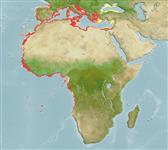
marino demersale; distribuzione batimetrica 15 - 200 m (Ref. 5222), usually 15 - 50 m (Ref. 2683). Subtropical; 43°N - 16°S, 20°W - 38°E (Ref. 5222)
Eastern Atlantic: Portugal to southern Angola; reports from islands require confirmation. Specimens from Madeira, Azores, Canary Islands, and Cape Verde have been examined by Heemstra (1991, Ref. 6512) and are identified to be Mycteroperca fusca. Replaced by Mycteroperca acutirostris in the western Atlantic.
Lunghezza alla prima maturità / Dimensione / Peso / Età
Maturità: Lm 34.0, range 32 - 36 cm
Max length : 144 cm TL maschio/sesso non determinato; (Ref. 40637); common length : 80.0 cm TL maschio/sesso non determinato; (Ref. 2683); peso massimo pubblicato: 49.7 kg (Ref. 40637)
Breve descrizione
Chiavi di identificazione | Morfologia | Morfometria
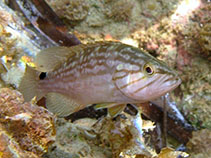
Spine dorsali (totale) : 11; Raggi dorsali molli (totale) : 15 - 17; Spine anali: 3; Raggi anali molli: 11 - 12. Distinguished by the following characteristics: usually reddish brown, sometimes mottled with black or pale grey spots with black streak above maxilla; juveniles with black saddle blotch on peduncle; oblong body, compressed, depth contained 2.8-3.2 times in SL; head length 2.5-2.7 in SL; convex interorbital area; enlarged serrae at angle of preopercle, forming rounded lobe set off by the indentation immediately above; nostrils subequal in juveniles, posterior nostrils about twice that of anterior ones in adults (Ref. 89707).
Body shape (shape guide): fusiform / normal; Cross section: oval.
Occurs over rocky and sandy bottoms; young individuals very common in mangrove-lined lagoons. Feeds on mollusks (presumably cephalopods) and small fishes (Ref. 89707). Marketed fresh.
Ciclo vitale e comportamento di accoppiamento
Maturità | Riproduzione | Deposizione | Uova | Fecondità | Larve
Heemstra, P.C. and J.E. Randall, 1993. FAO Species Catalogue. Vol. 16. Groupers of the world (family Serranidae, subfamily Epinephelinae). An annotated and illustrated catalogue of the grouper, rockcod, hind, coral grouper and lyretail species known to date. Rome: FAO. FAO Fish. Synop. 125(16):382 p. (Ref. 5222)
Stato della Lista Rossa IUCN (Ref. 130435: Version 2025-2 (Global))
Minaccia per l'uomo
Harmless
Usi umani
Pesca: scarso interesse commerciale
Strumenti
Rapporti speciali
Scarica XML
Fonti Internet
Stime basate su modelli
Temperatura preferita (Fonte Biblio.
123201): 15.3 - 27.4, mean 19.4 °C (based on 296 cells).
Indice di diversità filogenetica (Fonte Biblio.
82804): PD
50 = 0.5000 [Uniqueness, from 0.5 = low to 2.0 = high].
Bayesian length-weight: a=0.01072 (0.00689 - 0.01668), b=3.01 (2.89 - 3.13), in cm total length, based on LWR estimates for this species & Genus-body shape (Ref.
93245).
Livello trofico (Fonte Biblio.
69278): 4.1 ±0.58 se; based on food items.
Generation time: 10.4 ( na - na) years. Estimated as median ln(3)/K based on 1
growth studies.
Resilienza (Fonte Biblio.
120179): Molto basso, tempo minimo di raddoppiamento della popolazione più di 14 anni (Preliminary K or Fecundity.).
Vulnerabilità della pesca (Ref.
59153): High to very high vulnerability (67 of 100).
🛈
Nutrienti (Ref.
124155): Calcium = 34.6 [15.2, 67.1] mg/100g; Iron = 0.82 [0.44, 1.54] mg/100g; Protein = 18.6 [16.6, 20.2] %; Omega3 = 0.331 [0.208, 0.544] g/100g; Selenium = 40.9 [19.7, 83.1] μg/100g; VitaminA = 13.4 [4.2, 49.3] μg/100g; Zinc = 0.474 [0.334, 0.700] mg/100g (wet weight);