Περιβάλλον: περιβάλλον / κλιματική ζώνη / εύρος βάθους / εύρος διανομής
Οικολογία
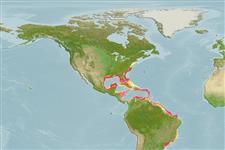
Θαλασσινό(ά); Υφάλμυρο Υφαλόφιλο(α); ωκεανόδρομο(ς) (Ref. 51243); εύρος βάθους 30 - 160 m (Ref. 89707). Subtropical; 40°N - 27°S, 98°W - 38°W (Ref. 5222)
Western Atlantic: North Carolina, USA (with juveniles occurring as far north as Massachusetts) to the Yucatan Peninsula, Mexico. Rare in Bermuda; one record in Cuba; also reported from eastern Brazil.
Μήκος κατά την πρώτη ωρίμανση / Μέγεθος / Βάρος / Ηλικία
Γεννητική Ωρίμανση: Lm 63.1, range 51 - ? cm
Max length : 145 cm TL αρσενικό/απροσδιόριστο; (Ref. 40637); common length : 50.0 cm TL αρσενικό/απροσδιόριστο; (Ref. 3708); μεγ. δημοσιευμένο βάρος: 36.5 kg (Ref. 40637); μεγ. αναφερόμενη ηλικία: 31 έτη (Ref. 118445)
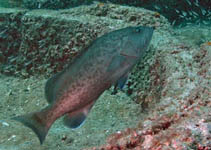
Ραχιαίες άκανθες (συνολικά) : 11; Μαλακές ραχιαίες ακτίνες (συνολικά) : 16 - 18; Εδρικές άκανθες: 3; Μαλακές εδρικές ακτίνες: 10 - 12. Distinguished by the following characteristics: adult females and juveniles are generally brownish grey with dark vermiculations; camouflage phase has 5 dark brown saddles separated by short white bars below the dorsal fin; large males sometimes display a "black-belly" and "black-back" phase; black-belly phase is mostly pale grey, with faint dark reticulations below soft dorsal fin, belly and ventral part of the body above anal fin black, as are margin of the soft dorsal fin, central rear part of caudal fin and rear margins of pectoral and pelvic fins; depth of body contained 3.0-3.5 times in SL; head length 2.5-2.7 times in SL; convex interorbital area; angle of preopercle produced into a rounded lobe bearing enlarged serrae; posterior nostrils of adults much larger than anterior ones; smooth lateral body scales, except those covering pectoral fin (Ref. 89707).
Body shape (shape guide): fusiform / normal.
Juveniles occur in estuaries and seagrass beds; adults are usually found offshore on rocky bottom (rarely to 152 m), occasionally inshore on rocky or grassy bottom. It is the most common grouper on rocky ledges in the eastern Gulf of Mexico. Adults are either solitary or in groups of 5 to 50 individuals; feed mainly on fishes, some crabs, shrimps, and cephalopods. Juveniles (less than 20 cm) feed mainly on crustaceans that live in shallow grass beds.
Indeterminate, multiple spawner (Ref. 86690).
Heemstra, P.C. and J.E. Randall, 1993. FAO Species Catalogue. Vol. 16. Groupers of the world (family Serranidae, subfamily Epinephelinae). An annotated and illustrated catalogue of the grouper, rockcod, hind, coral grouper and lyretail species known to date. Rome: FAO. FAO Fish. Synop. 125(16):382 p. (Ref. 5222)
Κατάσταση Κόκκινου Καταλόγου IUCN (Ref. 130435: Version 2025-2 (Global))
Απειλή για τον άνθρωπο
Harmless
Ανθρώπινες χρήσεις
αλιεία: πολύ εμπορικό; αλιεία αναψυχής: ναί
Εργαλεία
Ειδικές εκθέσεις
Λήψη XML
Διαδικτυακές πηγές
Εκτιμήσεις βάσει μοντέλων
Προτιμώμενη θερμοκρασία (Αναφ.
123201): 18.3 - 27.1, mean 23.8 °C (based on 123 cells).
Δείκτης φυλογενετικής ποικιλότητας (Αναφ.
82804): PD
50 = 0.5000 [Uniqueness, from 0.5 = low to 2.0 = high].
Bayesian length-weight: a=0.00955 (0.00770 - 0.01184), b=3.04 (3.01 - 3.07), in cm total length, based on LWR estimates for this species (Ref.
93245).
Τροφικό Επίπεδο (Αναφ.
69278): 3.7 ±0.4 se; based on diet studies.
Ελαστικότητα (Αναφ.
120179): Μεσαίο(α), ελάχιστος χρόνος για διπλασιασμό πληθυσμού 1,4 - 4,4 έτη (K=0.12-0.16; tm=3-8; tmax=16; Fec>10,000).
Prior r = 0.51, 95% CL = 0.34 - 0.77, Based on 1 full stock assessment.
Ευπάθεια στην αλιεία (Ref.
59153): High vulnerability (62 of 100).
🛈
Ευπάθεια στο κλίμα (Ref.
125649): High to very high vulnerability (73 of 100).
🛈
Θρεπτικά συστατικά (Ref.
124155): Calcium = 11.5 [6.4, 24.2] mg/100g; Iron = 0.464 [0.235, 0.829] mg/100g; Protein = 19.5 [17.6, 21.1] %; Omega3 = 0.214 [0.122, 0.378] g/100g; Selenium = 24.6 [12.6, 49.8] μg/100g; VitaminA = 38.1 [11.4, 150.0] μg/100g; Zinc = 0.57 [0.38, 0.89] mg/100g (wet weight);