Entorno: milieu / zona climática / rango de profundidad / gama de distribución
Ecología
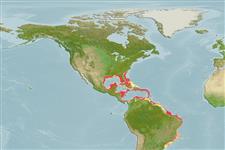
marino asociado a arrecife; rango de profundidad 2 - 150 m (Ref. 5222), usually 2 - 35 m (Ref. 40849). Subtropical; 33°N - 28°S, 98°W - 28°W (Ref. 5222)
Western Atlantic: Gulf of Mexico, Bermuda, Caribbean (mainly insular localities), and Brazil.
Tamaño / Peso / Edad
Madurez: Lm ? range ? - ? cm
Max length : 84.0 cm TL macho / no sexado; (Ref. 40637); common length : 40.0 cm TL macho / no sexado; (Ref. 5217); peso máximo publicado: 10.2 kg (Ref. 40637); edad máxima reportada: 41 años (Ref. 36872)
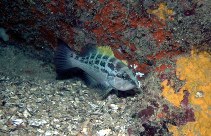
Espinas dorsales (total) : 11; Radios blandos dorsales (total) : 16 - 18; Espinas anales: 3; Radios blandos anales: 10 - 12. Distinguished by the following characteristics: Tan to brown above, paler below; upper parts of head and most of body usually have small, brown, close-set spots; sometimes uniformly brown. Adults have exerted rays that are even and about equal in length; 23-27 total gill rakers (Ref. 26938); depth of body 3.0-3.4 times in SL; head length 2.8-3.0 times in SL; angular preopercle, enlarged serrae on prominent lobe at the angle and a distinct notch above the serrate lobe; greatly enlarged posterior nostrils in adults (Ref. 89707).
Body shape (shape guide): fusiform / normal; Cross section: oval.
Found mainly on rocky or coral bottoms from the shoreline to at least 55 m depth; small and middle-sized individuals commonly occur in mangrove-lined lagoons. Feeds on fishes. Sex-reversal observed (Ref. 5521). More common in island waters than along the coast (Ref. 26938). The tricolored pattern of the juveniles mimics that of the juveniles of the clown wrasse, Halichoeres maculipinna. The aggressive mimic’s behavior includes folding down the median and caudal fins, which adds to its wrasse imitation and allows it to approach its otherwise wary prey (Ref. 43465). Marketed fresh; flesh is of good quality.
Ciclo vital y comportamiento de apareamiento
Madurez | Reproducción | Puesta | Huevos | Fecundidad | Larva
Pelagic spawner (Ref. 32199).
Heemstra, P.C. and J.E. Randall, 1993. FAO Species Catalogue. Vol. 16. Groupers of the world (family Serranidae, subfamily Epinephelinae). An annotated and illustrated catalogue of the grouper, rockcod, hind, coral grouper and lyretail species known to date. Rome: FAO. FAO Fish. Synop. 125(16):382 p. (Ref. 5222)
Situación en la Lista Roja de la UICN (Ref. 130435: Version 2025-2 (Global))
Amenaza para el ser humano
Harmless
Usos humanos
Pesquerías: comercial; pesca deportiva: si; Acuario: Acuarios públicos
Herramientas
Informes especiales
Descargar XML
Fuentes de Internet
Estimaciones basadas en modelos
Temperatura preferida (Referencia
123201): 23.3 - 28, mean 26.4 °C (based on 460 cells).
Índice de diversidad filogenética (Referencia
82804): PD
50 = 0.5000 [Uniqueness, from 0.5 = low to 2.0 = high].
Bayesian length-weight: a=0.00646 (0.00393 - 0.01061), b=3.06 (2.93 - 3.19), in cm total length, based on LWR estimates for this species & Genus-body shape (Ref.
93245).
Nivel trófico (Referencia
69278): 4.5 ±0.8 se; based on diet studies.
Resiliencia (Referencia
120179): Bajo, población duplicada en un tiempo mínimo de 4.5-14 años (K=0.06; tmax=41).
Vulnerabilidad pesquera (Ref.
59153): High to very high vulnerability (67 of 100).
🛈
Nutrientes (Ref.
124155): Calcium = 12.7 [7.2, 26.6] mg/100g; Iron = 0.445 [0.222, 0.786] mg/100g; Protein = 19.2 [17.4, 20.9] %; Omega3 = 0.22 [0.13, 0.39] g/100g; Selenium = 20.6 [9.7, 42.8] μg/100g; VitaminA = 86.4 [25.1, 331.4] μg/100g; Zinc = 0.542 [0.353, 0.817] mg/100g (wet weight);