Umwelt: Milieu / Klimazone / Tiefenbereich / Verbreitungsgebiet
Ökologie
seewasser riff-verbunden; tiefenbereich 60 - 250 m (Ref. 89707). Subtropical; 33°N - 27°S, 95°W - 33°W (Ref. 5222)
Western Atlantic: Bermuda and Massachusetts, USA to southern Brazil, including the southern Gulf of Mexico and the Caribbean. Adults are unknown from the northeastern coast of the USA.
Länge bei der ersten Reifung / Größe / Gewicht / Alter
Geschlechtsreife: Lm 67.7, range 47 - 95.1 cm
Max length : 150 cm TL Männchen/unbestimmt; (Ref. 40637); common length : 70.0 cm TL Männchen/unbestimmt; (Ref. 5217); max. veröff. Gewicht: 100.0 kg (Ref. 26340)
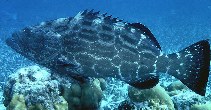
Rückenflossenstacheln (insgesamt) : 11; Rückenflossenweichstrahlen (insgesamt) : 15 - 17; Afterflossenstacheln: 3; Afterflossenweichstrahlen: 11 - 13. Distinguished by the following characteristics: Side body has rectangular dark gray blotches. Outer third of second dorsal, anal and caudal fins black. Edge of preopercle smooth, without pronounced lobe at angle; 17-24 total gill rakers (Ref. 26938); depth of body 3.3-3.5 times in SL; head length 2.5-2.8 times in SL; evenly rounded preopercle, without distinct notch or lobe at the angle; subequal sizes of anterior and posterior nostrils (Ref. 89707).
Body shape (shape guide): fusiform / normal; Cross section: oval.
Minimum depth from Ref. 126840. A solitary species (Ref. 26340) inhabiting rocky and coral reefs (Ref. 9710). Adults feed primarily on fishes; juveniles mainly on crustaceans. Oviparous (Ref. 205). A protogynous hermaphrodite (Ref. 55367). Forms spawning aggregations (Ref. 55367). Common but difficult to approach (Ref. 9710). Marketed fresh and its flesh is of excellent quality.
A monandric species (Ref. 55367). According to a study in Campeche Bank, females changed sex between 85.5 and 125.0 cm FL, with median length of 103.3 cm FL. At 114.5 cm FL, 50% of the females in the sample had transformed into males. Age at sex change = 15.5 years (Ref. 55367).
Heemstra, P.C. and J.E. Randall, 1993. FAO Species Catalogue. Vol. 16. Groupers of the world (family Serranidae, subfamily Epinephelinae). An annotated and illustrated catalogue of the grouper, rockcod, hind, coral grouper and lyretail species known to date. Rome: FAO. FAO Fish. Synop. 125(16):382 p. (Ref. 5222)
IUCN Rote Liste Status (Ref. 130435: Version 2025-2 (Global))
Bedrohung für Menschen
Reports of ciguatera poisoning (Ref. 31172)
Nutzung durch Menschen
Fischereien: hoch kommerziell; Sportfisch: ja; Aquarium: Öffentliche Aquarien
Tools
Zusatzinformationen
Download XML
Internet Quellen
Schätzungen auf der Grundlage von Modellen
Phylogenetischer Diversitätsindex (Ref.
82804): PD
50 = 0.5000 [Uniqueness, from 0.5 = low to 2.0 = high].
Bayesian length-weight: a=0.01047 (0.00845 - 0.01298), b=3.05 (3.02 - 3.08), in cm total length, based on LWR estimates for this species (Ref.
93245).
Trophische Ebene (Ref.
69278): 4.3 ±0.5 se; based on diet studies.
Widerstandsfähigkeit (Ref.
120179): mittel, Verdopplung der Population dauert 1,4 - 4,4 Jahre. (K=0.16; tmax=14; Fec=500,000).
Prior r = 0.49, 95% CL = 0.33 - 0.74, Based on 1 data-limited stock assessment.
Anfälligkeit der Fischerei (Ref.
59153): High vulnerability (63 of 100).
🛈
Klimaanfälligkeit (Ref.
125649): Very high vulnerability (88 of 100).
🛈
Nährstoffe (Ref.
124155): Calcium = 10.6 [6.2, 22.4] mg/100g; Iron = 0.455 [0.225, 0.794] mg/100g; Protein = 19.5 [17.6, 21.1] %; Omega3 = 0.222 [0.129, 0.386] g/100g; Selenium = 27.9 [14.5, 53.2] μg/100g; VitaminA = 43.2 [14.9, 149.7] μg/100g; Zinc = 0.414 [0.279, 0.638] mg/100g (wet weight); based on
nutrient studies.