Περιβάλλον: περιβάλλον / κλιματική ζώνη / εύρος βάθους / εύρος διανομής
Οικολογία
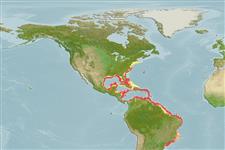
Θαλασσινό(ά) βενθικό(ς); εύρος βάθους 30 - 525 m (Ref. 5222), usually 100 - 200 m (Ref. 5222). Subtropical; 41°N - 27°S, 98°W - 34°W (Ref. 5222)
Western Atlantic: Canada (Ref. 5951) to Massachusetts, USA to southern Brazil, including the Gulf of Mexico and the Caribbean.
Μήκος κατά την πρώτη ωρίμανση / Μέγεθος / Βάρος / Ηλικία
Γεννητική Ωρίμανση: Lm 54.0, range 47 - ? cm
Max length : 122 cm TL αρσενικό/απροσδιόριστο; (Ref. 26340); common length : 60.0 cm TL αρσενικό/απροσδιόριστο; (Ref. 5217); μεγ. δημοσιευμένο βάρος: 30.0 kg (Ref. 5222); μεγ. αναφερόμενη ηλικία: 27 έτη (Ref. 3090)
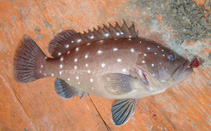
Ραχιαίες άκανθες (συνολικά) : 11; Μαλακές ραχιαίες ακτίνες (συνολικά) : 13 - 15; Εδρικές άκανθες: 3; Μαλακές εδρικές ακτίνες: 9. Distinguished by the following characteristics: Dark margin on spiny dorsal fin and dark saddle on caudal peduncle that extends below lateral line (Ref. 26938); juveniles with pale yellow caudal and pectoral fins; black saddle blotch on the caudal peduncle reaching below lateral line; depth of body contained 2.4-2.8 times in SL; head length 2.2-2.4 times in SL; convex interorbital area, width less than or subequal to eye diameter; enlarged serrae at angle of preopercle; distinctly convex upper edge of operculum; posterior nostrils 2-5 times larger than anterior nostrils (Ref. 89707).
Body shape (shape guide): fusiform / normal; Cross section: compressed.
Adults occur well offshore on rocky bottoms. Juveniles may be found inshore and are often reported from the northeastern coast of the U.S (Ref. 89707). Adults feed on fishes, gastropods, cephalopods, and brachyuran crustaceans (Ref. 5222). Valuable commercial food fish (Ref. 26938).
The size (76.7-109 cm) and age (8-29 yr) of 97 male specimens and the capture of two specimens undergoing sex change provided conclusive
evidence that snowy grouper are protogynous hermaphrodites (Ref. 45886).
Craig, M.T. and P.A. Hastings, 2007. A molecular phylogeny of the groupers of the subfamily Epinephelinae (Serranidae) with revised classification of the epinephelini. Ichthyol. Res. 54:1-17. (Ref. 83414)
Κατάσταση Κόκκινου Καταλόγου IUCN (Ref. 130435: Version 2025-2 (Global))
Απειλή για τον άνθρωπο
Harmless
Ανθρώπινες χρήσεις
αλιεία: Εμπορικό(ά); αλιεία αναψυχής: ναί
Εργαλεία
Ειδικές εκθέσεις
Λήψη XML
Διαδικτυακές πηγές
Εκτιμήσεις βάσει μοντέλων
Προτιμώμενη θερμοκρασία (Αναφ.
123201): 14.8 - 23.7, mean 19.5 °C (based on 93 cells).
Δείκτης φυλογενετικής ποικιλότητας (Αναφ.
82804): PD
50 = 0.5000 [Uniqueness, from 0.5 = low to 2.0 = high].
Bayesian length-weight: a=0.01549 (0.01194 - 0.02010), b=3.04 (3.01 - 3.07), in cm total length, based on LWR estimates for this species (Ref.
93245).
Τροφικό Επίπεδο (Αναφ.
69278): 4.0 ±0.58 se; based on food items.
Ελαστικότητα (Αναφ.
120179): Χαμηλό, ελάχιστος χρόνος για διπλασιασμό πληθυσμού 4,5 - 14 έτη (K=0.07-0.09; tmax=27).
Prior r = 0.17, 95% CL = 0.11 - 0.25, Based on 1 full stock assessment.
Ευπάθεια στην αλιεία (Ref.
59153): High vulnerability (64 of 100).
🛈
Ευπάθεια στο κλίμα (Ref.
125649): Moderate to high vulnerability (51 of 100).
🛈
Θρεπτικά συστατικά (Ref.
124155): Calcium = 34.8 [15.4, 66.9] mg/100g; Iron = 0.74 [0.39, 1.39] mg/100g; Protein = 18.6 [16.8, 20.3] %; Omega3 = 0.382 [0.237, 0.648] g/100g; Selenium = 49.2 [25.6, 92.7] μg/100g; VitaminA = 9.2 [3.1, 31.1] μg/100g; Zinc = 0.511 [0.367, 0.752] mg/100g (wet weight);