Entorno: milieu / zona climática / rango de profundidad / gama de distribución
Ecología
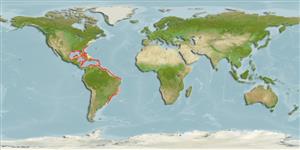
marino demersal; oceanodromo (Ref. 51243); rango de profundidad 55 - 525 m (Ref. 5222). Tropical; 43°N - 34°S, 98°W - 35°W
Western Atlantic: Massachusetts, USA to the Gulf of Mexico, Cuba, Trinidad, Rio de Janeiro and Sao Paulo (Ref. 47377), Brazil. Rare in the West Indies (Cuba, Haiti, and Trinidad). Reports from the eastern Pacific are apparently misidentifications of Epinephelus exsul.
Tamaño / Peso / Edad
Madurez: Lm ? range ? - ? cm
Max length : 230 cm TL macho / no sexado; (Ref. 5222); peso máximo publicado: 198.1 kg (Ref. 4699); edad máxima reportada: 91 años (Ref. 127586)
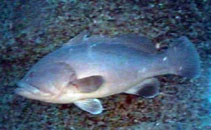
Espinas dorsales (total) : 10; Radios blandos dorsales (total) : 13 - 15; Espinas anales: 3; Radios blandos anales: 9. Distinguished by the following characteristics: dark reddish brown or brownish grey to almost black dorsally, dull reddish grey below; depth of body contained 2.4-2.6 times in SL; head length 2.1-2.5 times in SL; distinctly convex interorbital area; angular preopercle, rounded angle, with slightly enlarged serrae and with 1-2 small spines on lower edge just in front of angle; smooth interopercle and subopercle; subequal nostrils, posterior nostrils slightly larger; maxilla reaches well past eye; 4-5 rows of small teeth on midside part of lower jaw in adults and juveniles with 2-3 rows (Ref. 89707).
Body shape (shape guide): fusiform / normal.
A solitary species (Ref. 26340) usually found on rocky bottoms; juveniles are occasionally seen on jetties and shallow reefs (Ref. 89707). Adults feed on a variety of crabs, shrimps, lobsters, and fishes. Marketed fresh.
Ciclo vital y comportamiento de apareamiento
Madurez | Reproducción | Puesta | Huevos | Fecundidad | Larva
Craig, M.T. and P.A. Hastings, 2007. A molecular phylogeny of the groupers of the subfamily Epinephelinae (Serranidae) with revised classification of the epinephelini. Ichthyol. Res. 54:1-17. (Ref. 83414)
Situación en la Lista Roja de la UICN (Ref. 130435: Version 2025-2 (Global))
Amenaza para el ser humano
Harmless
Usos humanos
Pesquerías: comercial; pesca deportiva: si
Herramientas
Informes especiales
Descargar XML
Fuentes de Internet
Estimaciones basadas en modelos
Temperatura preferida (Referencia
123201): 13.8 - 23.1, mean 18.3 °C (based on 82 cells).
Índice de diversidad filogenética (Referencia
82804): PD
50 = 0.5000 [Uniqueness, from 0.5 = low to 2.0 = high].
Bayesian length-weight: a=0.01288 (0.00667 - 0.02490), b=3.05 (2.89 - 3.21), in cm total length, based on LWR estimates for this species & Genus-body shape (Ref.
93245).
Nivel trófico (Referencia
69278): 4.0 ±0.61 se; based on food items.
Resiliencia (Referencia
120179): Bajo, población duplicada en un tiempo mínimo de 4.5-14 años (K=0.05-0.14; tmax=24).
Vulnerabilidad pesquera (Ref.
59153): Very high vulnerability (85 of 100).
🛈
Vulnerabilidad climática (Ref.
125649): High to very high vulnerability (75 of 100).
🛈
Nutrientes (Ref.
124155): Calcium = 40.6 [19.0, 78.0] mg/100g; Iron = 0.705 [0.364, 1.349] mg/100g; Protein = 18.1 [16.2, 19.8] %; Omega3 = 0.233 [0.128, 0.425] g/100g; Selenium = 129 [65, 268] μg/100g; VitaminA = 8.85 [3.12, 28.03] μg/100g; Zinc = 0.619 [0.422, 0.939] mg/100g (wet weight);