Milieu: milieu / Klimaatzone / Diepte / verspreidingsgebied
Ecologie
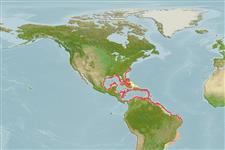
marien demersaal; diepte 90 - 360 m (Ref. 89707). Subtropical; 36°N - 28°S, 98°W - 34°W (Ref. 5222)
Western Atlantic: North Carolina, USA to southern Brazil, including Gulf of Mexico and the Caribbean.
Lengte bij maturiteit / Grootte / Gewicht / Leeftijd
Maturiteit: Lm ?, range 58 - ? cm
Max length : 115 cm TL mannelijk / geslacht onbekend; (Ref. 5222); common length : 50.0 cm TL mannelijk / geslacht onbekend; (Ref. 5217); max. gepubliceerd gewicht: 18.6 kg (Ref. 40637); max. gerapporteerde leeftijd: 35 Jaren (Ref. 36872)
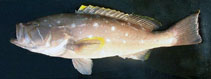
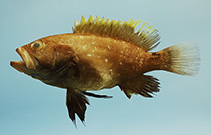
Dorsale stekels (totaal) : 11; Dorsale zachte stralen (totaal) : 13 - 15; Anale stekels: 3; Anale zachte stralen: 9. Distinguished by the following characteristics: buff or greyish brown head and body, whitish ventrally; yellow margins of dorsal and pectoral fins, sometimes including anal and caudal fins; pale blue line from the eye to the angle of preopercle; depth of body less than head length, contained 2.7-2.9 times in SL; head length 2.4-2.6 times in SL; convex interorbital area; angular preopercle, serrae at the angle distinctly enlarged; eye diameter equal to or greater than interorbital width in fish less than 45 cm SL; posterior and anterior nostrils subequal in size (Ref. 89707).
Body shape (shape guide): fusiform / normal; Cross section: compressed.
A solitary species (Ref. 26340) occurring in rocky areas and on sand mud bottom. On soft bottoms they are often seen in or near trenches or burrow-like excavations. Feeds on a wide variety of invertebrates (mainly brachyuran crabs) and fishes. Marketed fresh and considered good quality.
Levenscyclus en paargedrag
Maturiteit | Voortplanting | Paaien | Eieren | Fecunditeit | Larven
Craig, M.T. and P.A. Hastings, 2007. A molecular phylogeny of the groupers of the subfamily Epinephelinae (Serranidae) with revised classification of the epinephelini. Ichthyol. Res. 54:1-17. (Ref. 83414)
Status op de Rode Lijst van het IUCN (Ref. 130435: Version 2025-2 (Global))
Gevaar voor de mens
Harmless
Gebruik door de mens
Visserij: commercieel; sportvis: ja
Tools
Speciale rapporten
Download XML
Internetbronnen
Schattingen op basis van modellen
Gewenste temperatuur (Ref.
123201): 14.8 - 23.6, mean 19.6 °C (based on 59 cells).
Fylogenetische diversiteitsindex (Ref.
82804): PD
50 = 0.5000 [Uniqueness, from 0.5 = low to 2.0 = high].
Bayesian length-weight: a=0.01738 (0.00971 - 0.03111), b=3.05 (2.90 - 3.20), in cm total length, based on LWR estimates for this species & Genus-body shape (Ref.
93245).
Trofisch niveau (Ref.
69278): 3.8 ±0.61 se; based on food items.
Weerstandsvermogen (Ref.
120179): laag, minimale populatieverdubbelingstijd 4,5-14 jaar (K=0.10; tmax=35).
Prior r = 0.25, 95% CL = 0.16 - 0.37, Based on 1 full stock assessment.
Kwetsbaarheid van de visserij (Ref.
59153): High to very high vulnerability (66 of 100).
🛈
Kwetsbaarheid voor het klimaat (Ref.
125649): High to very high vulnerability (75 of 100).
🛈
Voedingsstoffen (Ref.
124155): Calcium = 38.8 [17.1, 74.5] mg/100g; Iron = 0.782 [0.423, 1.466] mg/100g; Protein = 18.6 [16.7, 20.2] %; Omega3 = 0.369 [0.233, 0.616] g/100g; Selenium = 45.9 [24.7, 85.6] μg/100g; VitaminA = 8.59 [2.99, 27.81] μg/100g; Zinc = 0.533 [0.386, 0.778] mg/100g (wet weight);