>
Gobiiformes (Gobies) >
Gobiidae (Gobies) > Gobiinae
Etymology: Neogobius: Greek, neos = new + Latin, gobius = gudgeon (Ref. 45335).
More on author: Pallas.
Окружающая среда: среда / климатическая зона / пределы глубины / диапазон распространения
экология
морской; пресноводный; солоноватоводный демерсальный; амфидромный (Ref. 46888); пределы глубины 0 - 30 m (Ref. 36771). Temperate; 4°C - 20°C (Ref. 2059); 60°N - 36°N, 18°E - 58°E
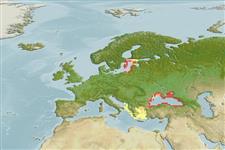
Europe and Asia: Sea of Azov, Black Sea and Caspian basins. Adverse ecological impact after introduction have been reported by several countries. In 2004, this was accidentally introduced in North America with ballast water in ships (Ref. 59043).
Длина при первой зрелости / Размер / Вес / Возраст
половая зрелость: Lm ?, range 4 - ? cm
Max length : 35.0 cm TL самец/пол неопределен; (Ref. 88073); наибольший вес (опубликованные данные): 381.42 g (Ref. 88073); наибольший возраст (опубликованны данные): 6 годы (Ref. 110985)
Краткое описание
определительные ключи | морфология | морфометрия
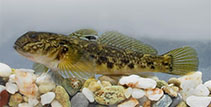
колючие лучи спинного плавника (общее число) : 7 - 8; членистые (мягкие) лучи спинного плавника (общее число) : 12 - 17; колючие лучи анального плавника: 1; членистые (мягкие) лучи анального плавника: 9 - 14; позвонки: 31 - 34. This species is distinguished from its congeners entering freshwater in Europe by the following characters: first branched ray of second dorsal about as long as penultimate ray; no scales on midline of nape, in front of preoperculum; pelvic-disc fraenum with small rounded lobes and the length is less than 1/6 of width at base; scales in midlateral series 45-54 + 2-3; a large black spot on the posterior part of first dorsal (Ref. 59043).
Body shape (shape guide): fusiform / normal.
Adults prefer shallow, brackish waters but also occur in fresh waters (Ref. 36771); in lagoons and lakes, large rivers, harbors, on sand or rock bottom; mostly found on well vegetated or rock bottom (Ref. 59043). Can tolerate a temperature range of 0 to 30°C, but mainly thrive in warm temperate waters; able to tolerate low oxygen content waters for several days (Ref. 36771). Oviparous, with demersal eggs (Ref. 36771). Longevity up to 4 years. Males reproduce for the first time at 3-4 years, females at 2-3 years. Spawning season in April to September; females may repeat spawning during a season, every 18-20 days; body of males entirely black during this season. Adhesive eggs deposited on stones, shells and aquatic plants; males guard eggs until hatching and usually die after spawning season. Egg clutches are supposed to be occasionally transported attached to the hull of ships, facilitating introduction to other areas. They feed on a wide variety of invertebrates and small fish, mostly on molluscs (Ref. 59043). Due to its large size, it has a major commercial value in some areas, especially in Azov Sea. It is usually salted, dried and consumed with beer (Ref. 92840).
Males protect embryos and juveniles (Ref. 36771). Males die after the spawning season (Ref. 36771).
Kottelat, M., 1997. European freshwater fishes. An heuristic checklist of the freshwater fishes of Europe (exclusive of former USSR), with an introduction for non-systematists and comments on nomenclature and conservation. Biologia, Bratislava, 52/Suppl. 5:1-271. (Ref. 13696)
Статус Красного Списка МСОП (Ref. 130435: Version 2025-2 (Global))
Угроза для людей
Potential pest
Использование человеком
рыболовство: коммерческий; аквариум: коммерческий; наживка: occasionally
дополнительная информация
инструменты
Специальные отчеты
Скачать в формате XML
ресурсы в Интернет
Оценки, основанные на моделях
Предпочтительная температура (ссылка
123201): 8.1 - 16.4, mean 14.2 °C (based on 168 cells).
Индекс филогенетического разнообразия (ссылка
82804): PD
50 = 0.5625 [Uniqueness, from 0.5 = low to 2.0 = high].
Bayesian length-weight: a=0.01122 (0.00952 - 0.01322), b=3.03 (2.98 - 3.08), in cm total length, based on LWR estimates for this species (Ref.
93245).
Трофический уровень (ссылка
69278): 3.3 ±0.1 se; based on diet studies.
Generation time: 10.0 ( na - na) years. Estimated as median ln(3)/K based on 2
growth studies.
устойчивость к внешним воздействиям (ссылка
120179): средний (среднего размера), минимальное время удвоения популяции 1.4-4.4 года (tm=2-4; tmax=4; Fec=300).
Уязвимость рыбной ловли (Ref.
59153): Low to moderate vulnerability (26 of 100).
🛈