>
Scombriformes (Mackerels) >
Scombridae (Mackerels, tunas, bonitos) > Scombrinae
Etymology: Scomberomorus: Latin, scomber = mackerel + Greek, moros = silly, stupid (Ref. 45335).
More on author: Cuvier.
Miljö: miljö / Klimatzon / djupintervall / distributionsområde
Ekologi
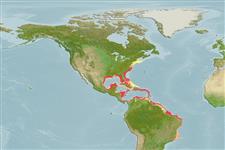
marina pelagic-neritic; havsvandrande (Ref. 51243); djupintervall 5 - 140 m (Ref. 36484), usually 5 - 15 m (Ref. 40849). Tropical; 44°N - 22°S, 98°W - 34°W (Ref. 54879)
Western Atlantic: Canada (Ref. 5951) to Massachusetts, USA to São Paulo, Brazil. Eastern Central Atlantic: St. Paul's Rocks (Ref. 13121).
Längd vid första mognad / Storlek / Vikt / Ålder
Könsmognad: Lm 64.8, range 45 - 114 cm
Max length : 184 cm TL hane/ej könsbestämd; (Ref. 9710); common length : 70.0 cm FL hane/ej könsbestämd; (Ref. 168); publicerad maxvikt: 45.0 kg (Ref. 168); rapporterad maxålder: 26 år (Ref. 128047)
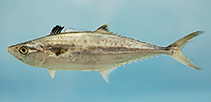
Taggstrålar i ryggfenan (totalt) : 12 - 18; Mjukstrålar i ryggfenan (totalt) : 15 - 18; Taggstrålar i analfenan: 0; Mjukstrålar i analfenan: 16 - 20; Ryggkotor: 41 - 43. Interpelvic process small and bifid. Swim bladder absent. Lateral line abruptly curving downward below second dorsal fin. Intestine with 2 folds and 3 limbs. Adults have no black area on the anterior part of the first dorsal fin. Juveniles with bronze spots in 5 or 6 irregular rows. Body entirely covered with scales.
Body shape (shape guide): fusiform / normal; Cross section: oval.
Often found in outer reef areas. Larvae are encountered in surface waters of 26.3° to 31°C and 26.9 to 35 ppt. Feeds primarily on fishes with smaller quantities of penaeid shrimps and squids. Large schools have been found to migrate over considerable distances along the Atlantic US coast, water temperature permitting. It is an important species for recreational, commercial, and artisanal fisheries throughout its range. Most of the catch is processed into steaks or sold fresh, or sometimes canned and salted. Also prepared smoked and frozen (Ref. 9987). Potentially ciguatoxic in certain areas (Ref. 9710). Sometimes called "Kingfish" (Ref. 13442).
Collette, B.B. and C.E. Nauen, 1983. FAO Species Catalogue. Vol. 2. Scombrids of the world. An annotated and illustrated catalogue of tunas, mackerels, bonitos and related species known to date. Rome: FAO. FAO Fish. Synop. 125(2):137 p. (Ref. 168)
Status på IUCN:s rödlista (Ref. 130435: Version 2025-2 (Global))
Hot mot människor
Reports of ciguatera poisoning (Ref. 9710)
Mänskliga användningsområden
Fiskeri: kommersiell; sportfisk: ja
Verktyg
Särskilda rapporter
Ladda ner XML
Internet-källor
Uppskattningar baserade på modeller
Önskad temperatur (Ref.
123201): 23.5 - 28.1, mean 27.2 °C (based on 1034 cells).
Index för fylogenetisk mångfald (Ref.
82804): PD
50 = 0.5000 [Uniqueness, from 0.5 = low to 2.0 = high].
Bayesian length-weight: a=0.00912 (0.00716 - 0.01162), b=3.02 (2.98 - 3.06), in cm total length, based on LWR estimates for this species (Ref.
93245).
Trofisk nivå (Ref.
69278): 4.4 ±0.3 se; based on diet studies.
Generation time: 6.1 (4.5 - 7.3) years. Estimated as median ln(3)/K based on 31
growth studies.
Resiliens (Ref.
120179): Mellan, lägsta populationsfördubblingstid 1,4-4,4 år (K=0.07-0.15; tm=2; tmax=14; Fec=70,000).
Prior r = 0.47, 95% CL = 0.31 - 0.71, Based on 3 full stock assessments.
Sårbarhet i fisket (Ref.
59153): Moderate to high vulnerability (48 of 100).
🛈
Sårbarhet för klimatet (Ref.
125649): Moderate to high vulnerability (55 of 100).
🛈
Näringsämnen (Ref.
124155): Calcium = 20.3 [9.2, 71.9] mg/100g; Iron = 0.707 [0.314, 1.640] mg/100g; Protein = 20.6 [19.4, 21.9] %; Omega3 = 0.238 [0.149, 0.393] g/100g; Selenium = 74.7 [27.2, 232.8] μg/100g; VitaminA = 17.7 [4.4, 77.8] μg/100g; Zinc = 0.568 [0.380, 0.903] mg/100g (wet weight); based on
nutrient studies.