>
Siluriformes (Catfishes) >
Bagridae (Bagrid catfishes)
Etymology: Pseudomystus: Greek, pseudes = false + Greek, mystax = whiskered, used by Belon in 1553 to describe all fishes with whiskers (Ref. 45335).
More on author: Regan.
Environnement : milieu / zone climatique / profondeur / gamme de distribution
Écologie
; eau douce démersal; pH range: 6.0 - 8.0; dH range: 4 - 25. Tropical; 20°C - 26°C (Ref. 2060)
Asia: Chao Phraya and Mekong basins (Ref. 27732). Reported from Maeklong, Peninsular and Southeast Thailand river systems (Ref. 26336).
Taille / Poids / Âge
Maturité: Lm ? range ? - ? cm
Max length : 18.0 cm TL mâle / non sexé; (Ref. 118477)
Description synthétique
Clés d'identification | Morphologie | Morphométrie
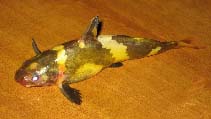
Épines dorsales (Total) : 1; Rayons mous dorsaux (Total) : 7; Rayons mous anaux: 16 - 17. Irregular vertical bars on a yellowish to dark grey background (sometime plain dark body); hyaline caudal fin with or without a single black blotch on each caudal lobe; short barbels (maxillary barbels not reaching base of pectoral spine); body depth at dorsal-fin origin larger than head width; a high, rounded adipose fin (Ref. 27732).
Body shape (shape guide): elongated.
Occurs in rivers and streams (Ref. 12693). Found in the basin wide tributary of the lower Mekong (Ref. 36667). Feeds on aquatic insect larvae, including odonatans. Adult females captured in February had well-developed ova. Spawning takes place at the beginning of the rainy season, with the young appearing in fishing nets during August. Market fresh (Ref. 12693).
Cycle de vie et comportement reproducteur
Maturité | Reproduction | Frai | Œufs | Fécondité | Larves
The male guards the eggs.
Kottelat, M., 1998. Fishes of the Nam Theun and Xe Bangfai basins, Laos, with diagnoses of twenty-two new species (Teleostei: Cyprinidae, Balitoridae, Cobitidae, Coiidae and Odontobutidae). Ichthyol. Explor. Freshwat. 9(1):1-128. (Ref. 27732)
Statut dans la liste rouge de l'IUCN (Ref. 130435: Version 2025-2 (Global))
Menace pour l'homme
Harmless
Utilisations par l'homme
Pêcheries: commercial; Aquarium: Commercial
Outils
Articles particuliers
Télécharger en XML
Sources Internet
Estimations basées sur des modèles
Indice de diversité phylogénétique (Réf.
82804): PD
50 = 0.5000 [Uniqueness, from 0.5 = low to 2.0 = high].
Bayesian length-weight: a=0.01000 (0.00614 - 0.01628), b=2.98 (2.84 - 3.12), in cm total length, based on LWR estimates for this species & (Sub)family-body (Ref.
93245).
Niveau trophique (Réf.
69278): 3.3 ±0.44 se; based on food items.
Résilience (Réf.
120179): Haut, temps minimum de doublement de population inférieur à 15 mois (Preliminary K or Fecundity.).
Vulnérabilité de la pêche (Ref.
59153): Low vulnerability (10 of 100).
🛈