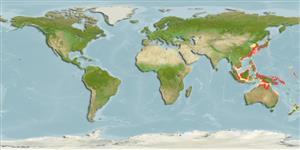
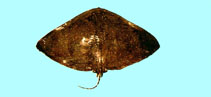
Environnement : milieu / zone climatique / profondeur / gamme de distribution
Écologie
marin démersal. Tropical
Northwest Pacific: southern Japan to the China seas. Possibly in Thailand (Ref. 9918). Reported from India (Ref. 45255).
Longueur à la première maturité / Taille / Poids / Âge
Maturité: Lm 57.0, range 55 - 59 cm
Max length : 100.0 cm TL mâle / non sexé; (Ref. 637)
Inhabits sandy or muddy bottom in shallow waters (Ref. 11230). Feeds on benthic animals. Spines covered with skin with poisonous glands. Ovoviviparous. Used as 'kamaboko' material (Ref. 637). Caught often by demersal trawl, trammel and gillnet fisheries, and occasionally using tangle nets.Utilized for its meat, but of limited value due to its typically small size (Ref.58048).
Cycle de vie et comportement reproducteur
Maturité | Reproduction | Frai | Œufs | Fécondité | Larves
Exhibit ovoviparity (aplacental viviparity), with embryos feeding initially on yolk, then receiving additional nourishment from the mother by indirect absorption of uterine fluid enriched with mucus, fat or protein through specialised structures (Ref. 50449). Distinct pairing with embrace (Ref. 205). Gives birth to ~3 pups; born between 20-22 cm WD (Ref.58048).
Masuda, H., K. Amaoka, C. Araga, T. Uyeno and T. Yoshino, 1984. The fishes of the Japanese Archipelago. Vol. 1. Tokai University Press, Tokyo, Japan. 437 p. (text). (Ref. 559)
Statut dans la liste rouge de l'IUCN (Ref. 130435: Version 2025-2 (Global))
Utilisations par l'homme
Pêcheries: bycatch
Outils
Articles particuliers
Télécharger en XML
Sources Internet
Estimations basées sur des modèles
Température préférée (Réf.
123201): 17.9 - 29.1, mean 28.1 °C (based on 1500 cells).
Indice de diversité phylogénétique (Réf.
82804): PD
50 = 0.5000 [Uniqueness, from 0.5 = low to 2.0 = high].
Bayesian length-weight: a=0.00851 (0.00393 - 0.01841), b=3.08 (2.88 - 3.28), in cm total length, based on LWR estimates for this (Sub)family-body shape (Ref.
93245).
Niveau trophique (Réf.
69278): 3.8 ±0.61 se; based on food items.
Résilience (Réf.
120179): Très faible, temps minimum de doublement de population supérieur à 14 ans (Fec assumed to be <10).
Vulnérabilité de la pêche (Ref.
59153): High vulnerability (60 of 100).
🛈