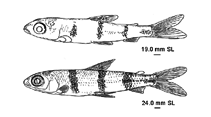
Taxonomic Remarks
See Géry (1964: 13, 72 and 74) for redescription, key and comparison with other species.
Meio ambiente: milieu / Zona climática / intervalo de profundidade / faixa de distribuição
Ecologia
; Água doce bentopelágico; pH range: 6.0 - 7.5; dH range: ? - 20. Tropical; 23°C - 27°C (Ref. 1672)
South America: Negro, Trombetas, Araguari, Nickerie, Coppename, and Oyapock River basins.
Tamanho / Peso / Idade
Maturidade: Lm ? range ? - ? cm
Max length : 13.1 cm SL macho/indeterminado; (Ref. 38289)
Long-lived and gregarious species. Occurs over sandy substrate (Ref. 27188). Frequently found in the rapids, thereby suggesting the need for a lot of space and well-aerated water for maintenance in the aquarium. Oviparous (Ref. 205). Can be caught using lines with crushed meat as bait but is also known to feed on plants. Is capable of powerful leaps out of the water (Ref. 12225).
Ciclo de vida ou comportamento de acasalamento
Maturidade | Reprodução | Desova | Ovos | Fecundidade | Larvas
Distinct pairing (Ref. 205).
Langeani, F., 1999. New species of Hemiodus (Ostariophysi, Characiformes, Hemiodontidae) from the Rio Tocantins, Brazil, with comments on color patterns and tooth shapes within the species and genus. Copeia 1999(3):718-722. (Ref. 31397)
Status na Lista Vermelha da UICN (Ref. 130435: Version 2025-2 (Global))
Ameaça para os humanos
Harmless
Uso pelos humanos
Pescarias: espécies comerciais; Aquário: Espécies comerciais
Ferramentas
Relatórios especiais
Baixar XML
Fontes da internet
Estimativas baseadas em modelos
Índice de diversidade filogenética (Ref.
82804): PD
50 = 0.5000 [Uniqueness, from 0.5 = low to 2.0 = high].
Bayesian length-weight: a=0.01096 (0.00514 - 0.02340), b=3.09 (2.91 - 3.27), in cm total length, based on LWR estimates for this Genus-body shape (Ref.
93245).
Nível Trófico (Ref.
69278): 2.6 ±0.27 se; based on food items.
Vulnerabilidade da pesca (Ref.
59153): Low vulnerability (10 of 100).
🛈