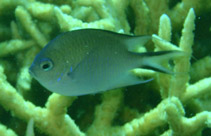
Taxonomic Remarks
Provisionally placed in Amblyglyphidodon.
Ambiente: milieu / zona climatica / distribuzione batimetrica / gamma di distribuzione
Ecologia
marino associati a barriera corallina; non migratori; distribuzione batimetrica 1 - 10 m (Ref. 90102). Tropical
Western Central Pacific: Philippines
Dimensione / Peso / Età
Maturità: Lm ? range ? - ? cm
Max length : 6.5 cm SL maschio/sesso non determinato; (Ref. 7247)
Breve descrizione
Chiavi di identificazione | Morfologia | Morfometria
Spine dorsali (totale) : 14; Raggi dorsali molli (totale) : 13 - 14; Spine anali: 2; Raggi anali molli: 14 - 15.
Body shape (shape guide): short and / or deep; Cross section: compressed.
Found near sheltered shores at shallow depth. Inhabits rich live corals in pairs or groups of juveniles and subadults (Ref. 90102). Plankton comprise the dominant natural food (Ref. 7247). Oviparous, distinct pairing during breeding (Ref. 205). Eggs are demersal and adhere to the substrate (Ref. 205). Males guard and aerate the eggs (Ref. 205). Lacks pelagic larval stage; young remains with parents during early stages (similar to Acanthochromis polyacanthus) (Ref. 90102).
Ciclo vitale e comportamento di accoppiamento
Maturità | Riproduzione | Deposizione | Uova | Fecondità | Larve
Oviparous, distinct pairing during breeding (Ref. 205). Eggs are demersal and adhere to the substrate (Ref. 205). Males guard and aerate the eggs (Ref. 205).
Allen, G.R., 1991. Damselfishes of the world. Mergus Publishers, Melle, Germany. 271 p. (Ref. 7247)
Stato della Lista Rossa IUCN (Ref. 130435: Version 2025-2 (Global))
Minaccia per l'uomo
Harmless
Usi umani
Strumenti
Rapporti speciali
Scarica XML
Fonti Internet
Stime basate su modelli
Indice di diversità filogenetica (Fonte Biblio.
82804): PD
50 = 0.6250 [Uniqueness, from 0.5 = low to 2.0 = high].
Bayesian length-weight: a=0.02344 (0.01149 - 0.04783), b=2.98 (2.80 - 3.16), in cm total length, based on LWR estimates for this (Sub)family-body shape (Ref.
93245).
Livello trofico (Fonte Biblio.
69278): 2.8 ±0.3 se; based on size and trophs of closest relatives
Resilienza (Fonte Biblio.
120179): Alto, tempo minimo di raddoppiamento della popolazione meno di 15 mesi (Preliminary K or Fecundity.).
Vulnerabilità della pesca (Ref.
59153): Low vulnerability (10 of 100).
🛈