>
Cypriniformes (Carps) >
Danionidae (Danios) > Chedrinae
Etymology: Engraulicypris: Greek, eggraulis, -eos = anchovy + Greek, kypris = the name of Aphrodite, proceeding from Kypris, (Cyprus), Greek, kyprinos = carp (Ref. 45335); brevianalis: The specific name brevianalis alludes to the relatively short anal fin (Ref. 116496).
More on author: Boulenger.
Entorno: milieu / zona climática / rango de profundidad / gama de distribución
Ecología
; agua dulce bentopelágico. Tropical; 11°S - 29°S
Africa: Limpopo River, Incomati River, Pongolo River, Saint Lucia system and Mkhuze River in Botswana, Zimbabwe, South Africa, Swaziland and Mozambique (Ref. 116496). Also known from Okavango (Ref. 7248, 52193), upper Zambezi system (Ref. 7248, 52193) and middle Luapula (upper Congo River basin) in Zambia (Ref. 52959). Reports from Orang River below Augrabies Falls (Ref. 7248, 33857, 52193) refer to Engraulicypris gariepinus (Ref. 116496).
Tamaño / Peso / Edad
Madurez: Lm ? range ? - ? cm
Max length : 7.5 cm SL macho / no sexado; (Ref. 52193)
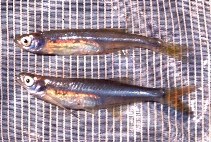
Espinas dorsales (total) : 0; Radios blandos dorsales (total) : 9 - 10; Espinas anales: 0; Radios blandos anales: 15 - 20; Vértebra: 37 - 38. Diagnosis: Caudal fin membrane clear towards vivid yellow at fork; anal fin extending two thirds of length of caudal peduncle; caudal peduncle moderately long; operculum entirely, not partially, shiny; body midline silver, not black; iris dark to light grey, not white; head with tubercles along lower jaw and lower head in breeding males; snout rounded, not pointed, darker dorsally; pelvic fin melanophores absent (Ref. 116496).
Body shape (shape guide): fusiform / normal.
Pelagic species preferring close proximity to substrate and seeking out slacker areas such as backwater, eddies and pools below riffles (Ref. 116496). It occurs in shoals and prefers well-aerated, open water in flowing rivers, favouring the upper stratum (Ref. 7248, 52193, 116496). Feeds from water column on planktonic crustaceans and insects, such as midges and ants (Ref. 7248, 52193, 116496). Breeding occurs in early summer; appears to migrate up streams in spring to breed where it is found in tributaries (Ref. 7248, 116496).
Ciclo vital y comportamiento de apareamiento
Madurez | Reproducción | Puesta | Huevos | Fecundidad | Larva
Riddin, M.A., I.R. Bills and M.H. Villet, 2016. Phylogeographic, morphometric and taxonomic re-evaluation of the river sardine, Mesobola brevianalis (Boulenger, 1908) (Teleostei, Cyprinidae, Chedrini). ZooKeys 641:121-150. (Ref. 116496)
Situación en la Lista Roja de la UICN (Ref. 130435: Version 2025-2 (Global))
Amenaza para el ser humano
Harmless
Usos humanos
Herramientas
Informes especiales
Descargar XML
Fuentes de Internet
Estimaciones basadas en modelos
Índice de diversidad filogenética (Referencia
82804): PD
50 = 0.5039 [Uniqueness, from 0.5 = low to 2.0 = high].
Bayesian length-weight: a=0.00708 (0.00333 - 0.01504), b=3.03 (2.85 - 3.21), in cm total length, based on LWR estimates for this species & (Sub)family-body (Ref.
93245).
Nivel trófico (Referencia
69278): 3.2 ±0.37 se; based on food items.
Resiliencia (Referencia
120179): Alto, población duplicada en un tiempo mínimo inferior a 15 meses (Preliminary K or Fecundity.).
Vulnerabilidad pesquera (Ref.
59153): Low vulnerability (10 of 100).
🛈