>
Gonorynchiformes (Milkfishes) >
Kneriidae (Shellears)
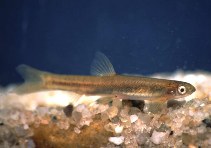
Etymology: Kneria: From Kner, that studied fishes in the Imperial Museum of Vienna, with Jean Natterer (1817) (Ref. 45335); auriculata: Refers to the cup-shaped process of the operculum on the male (Ref. 13721).
Eponymy: Dr Rudolf Kner (1810–1869) was an Austrian zoologist specialising in ichthyology. [...] (Ref. 128868), visit book page.
More on author: Pellegrin.
Environnement : milieu / zone climatique / profondeur / gamme de distribution
Écologie
; eau douce benthopélagique; potamodrome (Ref. 51243). Tropical; 9°C - 26°C (Ref. 88978); 17°S - 25°S
Africa: most mountain and plateau tributaries of the Zambezi, Pungwe, Buzi, Sabi/Save and Runde/Lundi rivers (Ref. 83372) in Zimbabwe, Zambia and Mozambique. Also in the upper Congo River basin (Lualaba, upper Lualaba, Lake Mweru and Luapula) (Ref. 45616) in Democratic Republic of the Congo and Zambia. A relict southern pocket occurs in the Crocodile (Incomati system), Transvaal (Ref. 7248, 52193). Identity of specimens from the Kafue and upper Zambezi requires confirmation (Ref. 52193). Not recorded from coastal areas (Ref. 5214).
Longueur à la première maturité / Taille / Poids / Âge
Maturité: Lm ?, range 5 - ? cm
Max length : 7.0 cm SL mâle / non sexé; (Ref. 52193); âge max. reporté: 2.50 années (Ref. 7248)
Description synthétique
Clés d'identification | Morphologie | Morphométrie
Épines dorsales (Total) : 0; Rayons mous dorsaux (Total) : 9 - 10; Épines anales: 0; Rayons mous anaux: 8 - 11.
Body shape (shape guide): elongated; Cross section: circular.
Usually found in small headwater streams with fast water associated with rapids and a boulder stream floor, with or without aquatic vegetation (Ref. 12524). Shoals occur in pools of small, clear, silt-free, rocky streams; reported to breathe air and to climb over damp rocks and up the sides of waterfalls during migrations (Ref. 13721, 52959). Can tolerate living out of the water for a long time if conditions are damp (Ref. 246, 5214, 13721). Scrapes diatoms, algae, and detritus from rock surfaces and also takes small aquatic insects such as mayfly nymphs and midge larvae; matures after a year; breeds in spring and summer, larger females bear up to 600 eggs (Ref. 52959). Moves on to flooded grasslands during the rainy season (Ref. 12524, 13337). Males and females have been observed swimming together, apparently joined side by side by means of the males' opercular disc (Ref. 12524).
Cycle de vie et comportement reproducteur
Maturité | Reproduction | Frai | Œufs | Fécondité | Larves
Male and female have been observed swimming side by side apparently joined by the opercular organ of the male; this is probably an adaptation to ensure the efficient external fertilization of ova in a flowing water environment (Ref. 88978). Breeding appears to be correlated with the start and ending of the rainy season; possibly exhibits multiple spawning over a prolonged breeding season (Ref. 88978).
Poll, M., 1984. Kneriidae. p. 129-133. In J. Daget, J.-P. Gosse and D.F.E. Thys van den Audenaerde (eds.) Check-list of the freshwater fishes of Africa (CLOFFA). ORSTOM, Paris and MRAC, Tervuren. Vol. 1. (Ref. 3565)
Statut dans la liste rouge de l'IUCN (Ref. 130435: Version 2025-2 (Global))
Menace pour l'homme
Harmless
Utilisations par l'homme
Pêcheries: d'intérêt potentiel; Aquarium: potentiel
Outils
Articles particuliers
Télécharger en XML
Sources Internet
Estimations basées sur des modèles
Indice de diversité phylogénétique (Réf.
82804): PD
50 = 0.5000 [Uniqueness, from 0.5 = low to 2.0 = high].
Bayesian length-weight: a=0.00389 (0.00180 - 0.00842), b=3.12 (2.94 - 3.30), in cm total length, based on all LWR estimates for this body shape (Ref.
93245).
Résilience (Réf.
120179): Haut, temps minimum de doublement de population inférieur à 15 mois (Lm=4.6-4.7).
Vulnérabilité de la pêche (Ref.
59153): Low vulnerability (10 of 100).
🛈