>
Stomiiformes (Lightfishes and dragonfishes) >
Stomiidae (Barbeled dragonfishes) > Melanostomiinae
Etymology: Eustomias: Greek, eu = good + Greek, stoma = mouth (Ref. 45335).
More on authors: Regan & Trewavas.
Environnement : milieu / zone climatique / profondeur / gamme de distribution
Écologie
marin bathypélagique; profondeur 0 - 1000 m (Ref. 11333). Deep-water; 13°N - 8°N
Eastern Atlantic: north of Senegal, but not at or east of Cape Verde, also at 6°N 35°W. Western Atlantic: Straits of Florida, Caribbean Sea and Puerto Rico. Also known from the Indian and West Pacific Oceans.
Taille / Poids / Âge
Maturité: Lm ? range ? - ? cm
Max length : 13.6 cm SL mâle / non sexé; (Ref. 4468); 12.0 cm SL (female)
Rayons mous dorsaux (Total) : 25 - 26; Rayons mous anaux: 37 - 38; Vertèbres: 68. Barbel with two terminal bulbs, distal one bearing tuft of filaments (Ref. 37473); separated by a long interspace, 1.7-3.8 times the length of distal bulb in specimens larger than 7 cm SL. Barbel length 31-82% SL except when developing. Terminal filaments short, 3-7 (less than 10% SL) without prominent bulblets, arising together from distal bulb or from a short distal stem; 1 filament thicker and longer than the rest. Some or all filaments with pigmented axes. Distal bulb ovoid , only slightly longer than wide, 1.2-2.5 times proximal-bulb length. Axis of stem and between bulbs variably pigmented; a black spot or cap almost always formed at proximal end of distal bulb. External chevron-shaped or roundish striated areas on stem unpigmented. Middorsal paired spots between occiput and dorsal-fin origin 7 or 8, sometimes 9 (Ref. 11333).
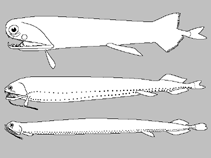
Body shape (shape guide): elongated.
Cycle de vie et comportement reproducteur
Maturité | Reproduction | Frai | Œufs | Fécondité | Larves
Gibbs, R.H. and M.A. Barnett, 1990. Melanostomiidae. p. 308-337. In J.C. Quero, J.C. Hureau, C. Karrer, A. Post and L. Saldanha (eds.) Check-list of the fishes of the eastern tropical Atlantic (CLOFETA). JNICT, Lisbon; SEI, Paris; and UNESCO, Paris. Vol. 1. (Ref. 4468)
Statut dans la liste rouge de l'IUCN (Ref. 130435: Version 2025-2 (Global))
Menace pour l'homme
Harmless
Utilisations par l'homme
Pêcheries: sans intérêt
Outils
Articles particuliers
Télécharger en XML
Sources Internet
Estimations basées sur des modèles
Température préférée (Réf.
123201): 5.1 - 6.6, mean 5.7 °C (based on 5 cells).
Indice de diversité phylogénétique (Réf.
82804): PD
50 = 0.5000 [Uniqueness, from 0.5 = low to 2.0 = high].
Bayesian length-weight: a=0.00302 (0.00115 - 0.00790), b=3.11 (2.88 - 3.34), in cm total length, based on LWR estimates for this (Sub)family-body shape (Ref.
93245).
Niveau trophique (Réf.
69278): 4.2 ±0.73 se; based on food items.
Résilience (Réf.
120179): Milieu, temps minimum de doublement de population : 1,4 à 4,4 années (Assuming tmax>3).
Vulnérabilité de la pêche (Ref.
59153): Low vulnerability (10 of 100).
🛈