การจำแนกประเภท / ชื่อ
ชื่อสามัญ | ชื่อพ้อง | Catalog of Fishes(สกุล, ชนิด) | ITIS | CoL | WoRMS | Cloffa
sub class Elasmobranchii (ฉลามและกระเบน) (sharks and rays) >
Myliobatiformes (Stingrays) >
Dasyatidae (Stingrays) > Urogymninae
Etymology: Urogymnus: Greek, oura = tail + Greek, gymnos = naked (Ref. 45335).
More on author: Bleeker.
สิ่งแวดล้อม : สิ่งแวดล้อม / เขตภูมิอากาศ / ระดับความลึก / ระยะการกระจายสินค้า
นิเวศวิทยา
; น้ำจืด; กร่อย สัตว์น้ำหน้าดิน; สัตว์น้ำจืดที่มีการอพยพอย่างแท้จริงภายในแหล่งน้ำจืดเท่านั้น (Ref. 51243). Tropical; 25°N - 20°S
Asia and Oceania: Mekong and Chao Phraya basins; also from eastern Borneo, New Guinea and northern Australia.
ความยาวเมื่อครบกำหนดครั้งแรก / ขนาด / น้ำหนัก / อายุ
วัยเจริญพันธุ์: Lm ?, range 110 - ? cm
Max length : 240 cm WD เพศผู้/กระเทย; (Ref. 27732); น้ำหนักสูงสุดที่มีการรายงาน: 600.0 kg (Ref. 6871)
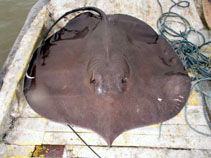
เงี่ยงครีบหลัง (รวม) : 0. Absence of ventral and dorsal skin folds on the tail, and the broad greyish to blackish marginal band on the ventral surface of the disc. The dorsal surface of the disc is brown (Ref. 27732). Spiral valve with 21 turns; dorsal surface with uniform brown or grey coloration (Ref. 12693). Lacking caudal fin; with long whip-like tail (Ref. 43281).
Body shape (shape guide): other.
Inhabits sandy bottoms in estuaries and large rivers (Ref. 12693). Feeds on benthic invertebrates (Ref. 12693) and fishes (Ref. 32457). Ovoviviparous (Ref. 50449). Caught occasionally by demersal gillnet and longline fisheries operating in riverine and estuarine areas. Utilized for its meat and possibly its cartilage (Ref.58048). Marketed fresh, with large individuals being sold in cut pieces by the kilogram (Ref. 12693). Size reaches to about 500 cm TL. Threatened due to over harvesting and pollution (Ref. 58490).
วงจรชีวิตและพฤติกรรมการผสมพันธุ์
วัยเจริญพันธุ์ | การสืบพันธุ์ | การวางไข่ | เซลสืบพันธ์ของเพศเมีย(ไข่) | ความดกของไข่ | ตัวอ่อน
Exhibit ovoviparity (aplacental viviparity), with embryos feeding initially on yolk, then receiving additional nourishment from the mother by indirect absorption of uterine fluid enriched with mucus, fat or protein through specialised structures (Ref. 50449). Distinct pairing with embrace (Ref. 205). Young are born at about 30 cm disc width (Ref. 6871).
Rainboth, W.J., 1996. Fishes of the Cambodian Mekong. FAO species identification field guide for fishery purposes. FAO, Rome, 265 p. (Ref. 12693)
สถานะบัญชีแดงของ IUCN (Ref. 130435: Version 2025-2 (Global))
ภัยคุกคามต่อมนุษย์
Venomous
การใช้ของมนุษย์
การประมง: มีการค้าเพียงเล็กน้อย; การเพาะเลี้ยงสัตว์น้ำ: การทดลอง; สถานที่แสดงสัตว์และพืชน้ำ: เป็นไปได้
เครื่องมือ
รายงานพิเศษ
ดาวน์โหลด XML
แหล่งที่มาจากอินเตอร์เน็ต
การประมาณค่าตามแบบจำลอง
ดัชนีความหลากหลายทางวิวัฒนาการ (อ้างอิง
82804): PD
50 = 0.5156 [Uniqueness, from 0.5 = low to 2.0 = high].
Bayesian length-weight: a=0.01023 (0.00482 - 0.02174), b=3.06 (2.86 - 3.26), in cm total length, based on LWR estimates for this (Sub)family-body shape (Ref.
93245).
ระดับชั้นอาหาร (อ้างอิง
69278): 3.5 ±0.37 se; based on food items.
ความสามารถในการกลับคืนสู่ปกติ (อ้างอิง
120179): ต่ำมาก, เวลาต่ำสุดที่จะทำให้ประชากรเพิ่มขึ้นเป็น 2 เท่าใช้เวลามากกว่า 14 ปี (Assuming Fec<10).
ความเสี่ยงต่อการตกปลา (Ref.
59153): Very high vulnerability (90 of 100).
🛈