>
Perciformes/Zoarcoidei (Eelpouts and pricklebacks) >
Zoarcidae (Eelpouts) > Lycodinae
Etymology: Bothrocara: Greek, bostrykos = cure of lack of hair + Tupí, guaraní, acará = the name of a fish. It could be also from Greek, kara = face (Ref. 45335).
More on author: Bean.
Umwelt: Milieu / Klimazone / Tiefenbereich / Verbreitungsgebiet
Ökologie
seewasser bathydemersal; tiefenbereich 129 - 2570 m (Ref. 50550), usually 457 - ? m (Ref. 2850). Deep-water
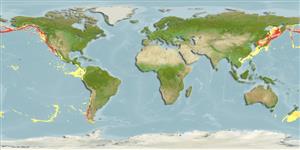
North Pacific: Sakhalin, Russia and Navarin Canyon in the Bering Sea to Attu Island in the Aleutian chain and Coronado Islands, Baja California, Mexico.
Größe / Gewicht / Alter
Geschlechtsreife: Lm ? range ? - ? cm
Max length : 74.0 cm TL Männchen/unbestimmt; (Ref. 80637)
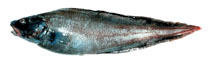
Rückenflossenstacheln (insgesamt) : 0; Rückenflossenweichstrahlen (insgesamt) : 100 - 112; Afterflossenstacheln: 0; Afterflossenweichstrahlen: 95 - 100. Dorsal and anal fins enveloped anteriorly in soft gelatinous tissue (Ref. 6885). Uniform light gray or brown, semi translucent, blue or black margins on dorsal and anal fins; color stronger posteriorly, transparent on narrow margins of unpaired fins; light on lining on mouth; black on peritoneum (Ref. 6885).
Body shape (shape guide): eel-like.
Found on mud or sandy-mud bottoms (Ref. 2850). The stomach contents indicate that it feeds upon a wide variety of bottom-dwelling organisms, probably eating anything it encounters that has food value and is small enough to ingest (Ref. 4525).
Lebenszyklus und Paarungsverhalten
Geschlechtsreife | Fortpflanzung | Ablaichen | Eier | Fruchtbarkeit | Larven
Eschmeyer, W.N., E.S. Herald and H. Hammann, 1983. A field guide to Pacific coast fishes of North America. Boston (MA, USA): Houghton Mifflin Company. xii+336 p. (Ref. 2850)
IUCN Rote Liste Status (Ref. 130435: Version 2025-2 (Global))
Bedrohung für Menschen
Harmless
Nutzung durch Menschen
Fischereien: bycatch
Tools
Zusatzinformationen
Download XML
Internet Quellen
Schätzungen auf der Grundlage von Modellen
Bevorzugte Temperatur (Ref.
123201): 0.2 - 4.8, mean 2.6 °C (based on 298 cells).
Phylogenetischer Diversitätsindex (Ref.
82804): PD
50 = 0.5039 [Uniqueness, from 0.5 = low to 2.0 = high].
Bayesian length-weight: a=0.00186 (0.00112 - 0.00310), b=3.25 (3.10 - 3.40), in cm total length, based on LWR estimates for this species & (Sub)family-body (Ref.
93245).
Trophische Ebene (Ref.
69278): 3.6 ±0.0 se; based on diet studies.
Widerstandsfähigkeit (Ref.
120179): mittel, Verdopplung der Population dauert 1,4 - 4,4 Jahre. (Fec=1,650-2,480).
Anfälligkeit der Fischerei (Ref.
59153): Moderate to high vulnerability (50 of 100).
🛈