>
Eupercaria/misc (Various families in series Eupercaria) >
Sciaenidae (Drums or croakers)
Etymology: Bairdiella: From Spencer Fullerton Baird (1823-1887) American naturalist and vertebrate zoologist leading authority in birds and mammals (Ref. 45335).
More on author: Lacepède.
Entorno: milieu / zona climática / rango de profundidad / gama de distribución
Ecología
marino; agua dulce; salobre demersal. Subtropical; 41°N - 21°N
Western Atlantic: New York to southern Florida in USA, and eastern and northern Gulf of Mexico to northern Mexico.
Longitud en la primera madurez / Tamaño / Peso / Edad
Madurez: Lm 9.3 range ? - ? cm
Max length : 30.0 cm TL macho / no sexado; (Ref. 7251); common length : 20.0 cm TL macho / no sexado; (Ref. 3702)
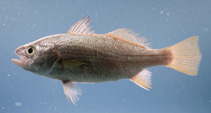
Espinas dorsales (total) : 10 - 11; Radios blandos dorsales (total) : 19 - 23; Espinas anales: 2; Radios blandos anales: 8 - 10. Colour silvery, greenish, or bluish above, bright silvery to yellowish on belly. Lower fins mostly yellowish to dusky. Mouth terminal, moderately large and oblique. Chin without barbel but with 6 mental pores (median pair often set in a pit). Preopercle with few spines at angle. Anal second spine sharp, more than 2/3 length of first soft ray. Gas bladder with 2 chambers. Anterior chamber yoke-shaped without appendages, posterior chamber simple, carrot-shaped. Lapillus enlarged, about 1/2 the size of sagitta (Ref 51721).
Body shape (shape guide): fusiform / normal.
Found in coastal waters over sandy and muddy bottoms. Moves to the nursery and feeding areas in estuaries during summer months and sometimes enters freshwaters. Feeds mainly on crustaceans, worms and occasionally fishes. Mostly used as bait.
Robins, C.R. and G.C. Ray, 1986. A field guide to Atlantic coast fishes of North America. Houghton Mifflin Company, Boston, U.S.A. 354 p. (Ref. 7251)
Situación en la Lista Roja de la UICN (Ref. 130435: Version 2025-2 (Global))
Amenaza para el ser humano
Harmless
Usos humanos
Pesquerías: escaso valor comercial; carnada: usually
Herramientas
Informes especiales
Descargar XML
Fuentes de Internet
Estimaciones basadas en modelos
Índice de diversidad filogenética (Referencia
82804): PD
50 = 0.5078 [Uniqueness, from 0.5 = low to 2.0 = high].
Bayesian length-weight: a=0.00871 (0.00792 - 0.00958), b=3.08 (3.05 - 3.11), in cm total length, based on LWR estimates for this species (Ref.
93245).
Nivel trófico (Referencia
69278): 3.2 ±0.0 se; based on diet studies.
Resiliencia (Referencia
120179): Alto, población duplicada en un tiempo mínimo inferior a 15 meses (tm<1; tmax=4).
Vulnerabilidad pesquera (Ref.
59153): Low vulnerability (20 of 100).
🛈
Nutrientes (Ref.
124155): Calcium = 156 [86, 374] mg/100g; Iron = 1.76 [0.89, 3.34] mg/100g; Protein = 19.6 [18.4, 20.8] %; Omega3 = 0.345 [0.185, 0.618] g/100g; Selenium = 27.3 [13.4, 58.6] μg/100g; VitaminA = 10.7 [3.4, 41.0] μg/100g; Zinc = 1.08 [0.73, 1.66] mg/100g (wet weight);