>
Eupercaria/misc (Various families in series Eupercaria) >
Labridae (Wrasses) > Scarinae
Etymology: Sparisoma: Latin, sparus = a fish with a golden head + Greek, soma = body (Ref. 45335).
More on author: Valenciennes.
Milieu: milieu / Klimaatzone / Diepte / verspreidingsgebied
Ecologie
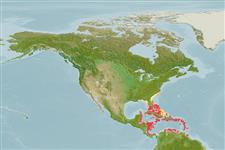
marien rifbewoner; diepte 1 - 15 m (Ref. 9710). Tropical; 42°N - 7°N, 88°W - 59°W (Ref. 88982)
Western Atlantic and the Caribbean. Confused with Southwest Atlantic specimens referring to Sparisoma axillare and Eastern Atlantic species referring to S. chaoti (Ref. 88982).
Lengte bij maturiteit / Grootte / Gewicht / Leeftijd
Maturiteit: Lm ?, range 16 - ? cm
Max length : 47.8 cm TL mannelijk / geslacht onbekend; (Ref. 13628)
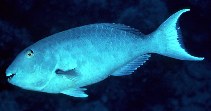
Dorsale stekels (totaal) : 9; Dorsale zachte stralen (totaal) : 10; Anale stekels: 3; Anale zachte stralen: 9. Juveniles and adults in drab phase (which are either mature males or females) are light grayish brown, nearly white ventrally; alternate dark and pale bars cross the chin; caudal peduncle and fin yellow; anal and pelvic fins red. Terminal phase males are dull green or blue-green with a large black spot on upper half of pectoral fin base; pectoral fins dark olive, the outer fifth abruptly pale (Ref. 13442).
Body shape (shape guide): fusiform / normal.
Inhabits coral reefs and seagrass beds. Juveniles or primary-phase fish can rapidly assume a mottled pattern as it comes to rest on the bottom. Spawning is usually a group activity in similarly colored males and females (Ref. 5521). A protogynous hermaphrodite (Ref. 55367).
Levenscyclus en paargedrag
Maturiteit | Voortplanting | Paaien | Eieren | Fecunditeit | Larven
Although protogyny was propossed for this species (Ref. 27876), probably because testicular characteristics showed a secondary characteristic of sex-changed males, observations of overlapping size ranges of males and females, and males maturing at the same ages and sizes as did females, strongly suggest gonochorism (Ref. 103751). A monandric species (Ref. 55367). Length at sex change = 25.0 cm TL (Ref. 55367). Forms leks during breeding (Ref. 55367).
Lieske, E. and R. Myers, 1994. Collins Pocket Guide. Coral reef fishes. Indo-Pacific & Caribbean including the Red Sea. Haper Collins Publishers, 400 p. (Ref. 9710)
Status op de Rode Lijst van het IUCN (Ref. 130435: Version 2025-2 (Global))
Gevaar voor de mens
Reports of ciguatera poisoning (Ref. 30303)
Gebruik door de mens
Visserij: van minder commercieel belang; Aquarium: Commercieel
Tools
Speciale rapporten
Download XML
Internetbronnen
Schattingen op basis van modellen
Gewenste temperatuur (Ref.
123201): 23.9 - 28.2, mean 27.5 °C (based on 467 cells).
Fylogenetische diversiteitsindex (Ref.
82804): PD
50 = 0.5000 [Uniqueness, from 0.5 = low to 2.0 = high].
Bayesian length-weight: a=0.01023 (0.00614 - 0.01704), b=3.01 (2.87 - 3.15), in cm total length, based on LWR estimates for this species & Genus-body shape (Ref.
93245).
Trofisch niveau (Ref.
69278): 2.0 ±0.0 se; based on diet studies.
Generation time: 1.9 ( na - na) years. Estimated as median ln(3)/K based on 1
growth studies.
Weerstandsvermogen (Ref.
120179): Hoog, minimale populatieverdubbelingstijd minder dan 15 maanden (K=0.5).
Kwetsbaarheid van de visserij (Ref.
59153): Low to moderate vulnerability (26 of 100).
🛈
Voedingsstoffen (Ref.
124155): Calcium = 49.2 [29.2, 92.7] mg/100g; Iron = 0.715 [0.384, 1.213] mg/100g; Protein = 18.5 [16.2, 20.8] %; Omega3 = 0.0933 [, ] g/100g; Selenium = 30.9 [17.7, 58.7] μg/100g; VitaminA = 40.1 [12.0, 135.4] μg/100g; Zinc = 1.6 [1.1, 2.5] mg/100g (wet weight);