>
Cypriniformes (Carps) >
Cyprinidae (Minnows or carps) > Labeoninae
Etymology: Labeo: Latin, labeo = one who has large lips (Ref. 45335); lukulae: Named after the river where the type material was collected (Ref. 26190).
Eponymy: A toponym referring to the Lukula (Lakula) River, Democratic Republic of Congo; the type locality. (Ref. 128868), visit book page.
More on author: Boulenger.
Environnement : milieu / zone climatique / profondeur / gamme de distribution
Écologie
; eau douce benthopélagique. Tropical; 15°N - 15°S
Africa: principal coastal basins of Cameroon to the Chiloango in Democratic Republic of the Congo; in the Congo basin known from the Kasai and Kwango in Angola, and the Aruwimi and Wagenia Falls in Democratic Republic of the Congo (Ref. 26192). Presence in the southern Congo basin in Angola not confirmed in Ref. 120641.
Taille / Poids / Âge
Maturité: Lm ? range ? - ? cm
Max length : 26.5 cm SL mâle / non sexé; (Ref. 81639)
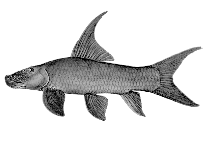
Rayons mous dorsaux (Total) : 12 - 13; Vertèbres: 29 - 31. Diagnosis: snout prominent, large and somewhat pointed, 44.6-60.0% of HL, with a deep and wide transverse furrow and ending in a fleshy appendage; scale formula: 34-37 (35 commonly observed); 4.5-6.5 (5.5 commonly observed); 3.0-4.5 (4.0 commonly observed); 13-17 (16 commonly observed); dorsal fin with 3 unbranched and 9-10 (10 commonly observed) branched rays; upper edge of dorsal fin always concave; 29-31 (30 commonly observed) vertebrae; ventral fin origin located under the 4th branched dorsal ray; genital opening distant from anal fin origin; no longitudinal band on flanks or spot on scaled base of caudal fin (Ref. 81639).
Body shape (shape guide): fusiform / normal.
Cycle de vie et comportement reproducteur
Maturité | Reproduction | Frai | Œufs | Fécondité | Larves
Tshibwabwa, S.M., 1997. Systématique des espèces africaines du genre Labeo (Teleostei, Cyprinidae) dans les régions ichtyogéographiques de Basse-Guinée et du Congo. II. Presses Universitaires de Namur, Namur, Belgique. 227 p. (Ref. 26192)
Statut dans la liste rouge de l'IUCN (Ref. 130435: Version 2025-2 (Global))
Menace pour l'homme
Harmless
Utilisations par l'homme
Pêcheries: sans intérêt
Outils
Articles particuliers
Télécharger en XML
Sources Internet
Estimations basées sur des modèles
Indice de diversité phylogénétique (Réf.
82804): PD
50 = 0.5000 [Uniqueness, from 0.5 = low to 2.0 = high].
Bayesian length-weight: a=0.00871 (0.00433 - 0.01753), b=3.04 (2.87 - 3.21), in cm total length, based on LWR estimates for this species & Genus-body shape (Ref.
93245).
Résilience (Réf.
120179): Milieu, temps minimum de doublement de population : 1,4 à 4,4 années (Preliminary K or Fecundity.).
Vulnérabilité de la pêche (Ref.
59153): Low vulnerability (22 of 100).
🛈