>
Eupercaria/misc (Various families in series Eupercaria) >
Labridae (Wrasses) > Scarinae
Etymology: Nicholsina: After J.T. Nichols, 1920-1941, curator in ichthyology, department of Fishes, American Museum of Nat. History; he has wrote articles in the Encyclopaedia Britannica.
Eponymy: John Treadwell Nichols (1883–1958) was an American ichthyologist, mammalogist and ornithologist. [...] (Ref. 128868), visit book page.
More on author: Valenciennes.
Taxonomic Remarks
Issue on validity of subspecies: subspecies considered as valid in FB, elevated to species rank as Nicholsina usta (Valenciennes, 1840) in Eschmeyer (CofF ver. Mar. 2011: Ref. 86697). Please send references, or more studies are needed.
Entorno: milieu / zona climática / rango de profundidad / gama de distribución
Ecología
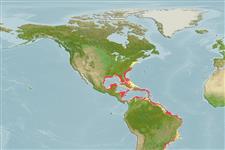
marino asociado a arrecife; rango de profundidad 1 - 80 m (Ref. 7360). Tropical; 41°N - 30°S, 98°W - 34°W
Western Atlantic: New Jersey, USA and northern Gulf of Mexico to Brazil. Absent in Bermuda, Bahamas and West Indies (except Greater Antilles).
Tamaño / Peso / Edad
Madurez: Lm ? range ? - ? cm
Max length : 30.0 cm TL macho / no sexado; (Ref. 7251); common length : 18.0 cm TL macho / no sexado; (Ref. 3802)
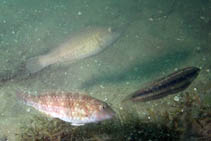
Espinas dorsales (total) : 9; Radios blandos dorsales (total) : 10; Espinas anales: 2; Radios blandos anales: 9. Body somewhat elongate, the depth contained 3 to 3.2 times in SL. Snout somewhat pointed; a small dermal cirrus at edge of anterior nostril; teeth fused only basally, thus not fully coalesced to form dental plates. Gill rakers 12 or 13. Caudal fin slightly rounded; pectoral fin-rays 13. Median predorsal scales 4 or 5; 1 row of scales on cheek. Colour: mottled olive green on back, the scales of sides with bluish white centres and reddish edges; head below level of mouth yellow; 2 diagonal narrow red-orange bands on cheek; median fins reddish, dorsal fin with a black blotch at front.
Body shape (shape guide): fusiform / normal.
Maximum depth from Ref. 52834. Inhabits seagrass beds and open bottom, mostly in shallow water. Larger adults live in deeper water. Not commonly marketed for food (Ref. 52834).
Ciclo vital y comportamiento de apareamiento
Madurez | Reproducción | Puesta | Huevos | Fecundidad | Larva
Distinct pairing (Ref. 205).
Robins, C.R. and G.C. Ray, 1986. A field guide to Atlantic coast fishes of North America. Houghton Mifflin Company, Boston, U.S.A. 354 p. (Ref. 7251)
Situación en la Lista Roja de la UICN (Ref. 130435: Version 2025-2 (Global))
Amenaza para el ser humano
Harmless
Usos humanos
Pesquerías: pesquerías de subsistencia
Herramientas
Informes especiales
Descargar XML
Fuentes de Internet
Estimaciones basadas en modelos
Temperatura preferida (Referencia
123201): 22.8 - 28, mean 25.7 °C (based on 400 cells).
Índice de diversidad filogenética (Referencia
82804): PD
50 = 0.6250 [Uniqueness, from 0.5 = low to 2.0 = high].
Bayesian length-weight: a=0.01288 (0.00620 - 0.02676), b=3.04 (2.87 - 3.21), in cm total length, based on LWR estimates for this (Sub)family-body shape (Ref.
93245).
Nivel trófico (Referencia
69278): 2.0 ±0.00 se; based on food items.
Resiliencia (Referencia
120179): Medio, población duplicada en un tiempo mínimo de 1.4-4.4 años (Preliminary K or Fecundity.).
Vulnerabilidad pesquera (Ref.
59153): Low vulnerability (20 of 100).
🛈
Nutrientes (Ref.
124155): Calcium = 58.2 [34.4, 108.5] mg/100g; Iron = 0.767 [0.420, 1.278] mg/100g; Protein = 18.5 [16.5, 20.3] %; Omega3 = 0.118 [0.071, 0.190] g/100g; Selenium = 39.3 [22.3, 70.8] μg/100g; VitaminA = 50.4 [15.4, 165.1] μg/100g; Zinc = 1.75 [1.20, 2.74] mg/100g (wet weight);