>
Eupercaria/misc (Various families in series Eupercaria) >
Priacanthidae (Bigeyes or catalufas)
Etymology: Heteropriacanthus: Greek, heteros = other + Greek, prion = saw + greek, akantha = thorn (Ref. 45335).
More on author: Lacepède.
Taxonomic Remarks
Two former synonyms resurrected: H. carolinus, widespread in Indo-Pacific, and H. fulgens in northeastern Atlantic.
Ambiente: milieu / zona climatica / distribuzione batimetrica / gamma di distribuzione
Ecologia
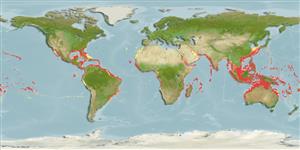
marino associati a barriera corallina; distribuzione batimetrica 3 - 300 m (Ref. 27000), usually 3 - 35 m (Ref. 40849). Subtropical; 33°N - 32°S, 180°W - 180°E
Atlantic and Southwest Indian Ocean. Formerly circumglobal.
Dimensione / Peso / Età
Maturità: Lm ? range ? - ? cm
Max length : 50.7 cm TL maschio/sesso non determinato; (Ref. 9990); common length : 20.0 cm SL maschio/sesso non determinato; (Ref. 55763); peso massimo pubblicato: 2.7 kg (Ref. 9990)
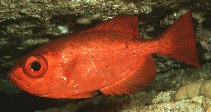
Spine dorsali (totale) : 10; Raggi dorsali molli (totale) : 12 - 13; Spine anali: 3; Raggi anali molli: 13 - 14. Silvery pink, mottled red or solid red in color; median fins with faint dark dots. Pelvic fins dusky or pale and without distinct spots (Ref. 4328). Section of preopercle behind canal striated and without scales (Ref. 26938).
Body shape (shape guide): fusiform / normal; Cross section: compressed.
Common in lagoon and seaward reefs, primarily around islands. Under or near ledges by day (Ref. 9710). Benthopelagic (Ref. 58302). Juvenile pelagic (Ref. 9335). Nocturnal (Ref. 5213), feeding mainly on octopi, pelagic shrimp, stomatopods, crabs, small fish, and polychaetes. Solitary (Ref. 5213). During the day usually occurs singly or in small groups but at dusk it may gather in large numbers (Ref. 37816). Known to produce sound. Marketed fresh (Ref. 3800). Minimum depth reported taken from Ref. 30874.
Ciclo vitale e comportamento di accoppiamento
Maturità | Riproduzione | Deposizione | Uova | Fecondità | Larve
Fernandez-Silva, I. and H.-C. Ho, 2017. Revision of the cicrumtropical glasseye fish Heteropriacanthus cruentatus (Perciformes: Priacanthidae), with resurrection of two species. Zootaxa 4273(3):341-361. (Ref. 115564)
Stato della Lista Rossa IUCN (Ref. 130435: Version 2025-2 (Global))
Minaccia per l'uomo
Reports of ciguatera poisoning (Ref. 30911)
Usi umani
Pesca: scarso interesse commerciale; Pesce da pesca sportiva: si; Acquario: Commerciale
Strumenti
Rapporti speciali
Scarica XML
Fonti Internet
Stime basate su modelli
Temperatura preferita (Fonte Biblio.
123201): 23.3 - 29, mean 27.4 °C (based on 2452 cells).
Indice di diversità filogenetica (Fonte Biblio.
82804): PD
50 = 0.6250 [Uniqueness, from 0.5 = low to 2.0 = high].
Bayesian length-weight: a=0.01585 (0.00991 - 0.02534), b=2.88 (2.75 - 3.01), in cm total length, based on LWR estimates for this species & (Sub)family-body (Ref.
93245).
Livello trofico (Fonte Biblio.
69278): 3.6 ±0.2 se; based on diet studies.
Resilienza (Fonte Biblio.
120179): Medio, tempo minimo di raddoppiamento della popolazione 1.4 - 4.4 anni (Preliminary K or Fecundity.).
Vulnerabilità della pesca (Ref.
59153): Moderate vulnerability (40 of 100).
🛈
Nutrienti (Ref.
124155): Calcium = 26.8 [15.1, 45.6] mg/100g; Iron = 0.664 [0.388, 1.058] mg/100g; Protein = 19.8 [18.7, 20.7] %; Omega3 = 0.249 [0.153, 0.401] g/100g; Selenium = 23.3 [12.4, 43.1] μg/100g; VitaminA = 51.3 [19.6, 136.6] μg/100g; Zinc = 0.625 [0.427, 0.901] mg/100g (wet weight);