>
Cypriniformes (Carps) >
Cyprinidae (Minnows or carps) > Smiliogastrinae
Etymology: Enteromius: Greek, enteron = intestine + Greek, myo, mys = muscle (Ref. 45335).
More on author: Boulenger.
Ambiente: milieu / zona climatica / distribuzione batimetrica / gamma di distribuzione
Ecologia
; acqua dolce benthopelagico; pH range: 6.0 - 6.5; dH range: ? - 8. Tropical; 24°C - 30°C (Ref. 1672)
Africa: Sanaga (Cameroon) to Chiloango basin (Republic of the Congo); also in the Chad basin (Ref. 81639). Occurs southwards to the lower reaches of Angolan Atlantic coastal rivers, including the Cuanza (Ref. 120641), although reports from the Lucala and Bengo rivers are misidentifications according to Ref. 11970; may need verification. Widespread in the Congo River basin, from the lower Congo (Ref. 41591) to the middle Luapula (Ref. 45616). Report from the Aruwimi (Ref. 41590) questionable (Ref. 106290).
Lunghezza alla prima maturità / Dimensione / Peso / Età
Maturità: Lm ?, range 4 - ? cm
Max length : 12.0 cm SL maschio/sesso non determinato; (Ref. 12311)
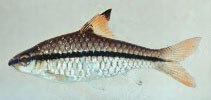
Spine dorsali (totale) : 1; Raggi dorsali molli (totale) : 10 - 11; Raggi anali molli: 7. Diagnosis: mouth subinferior; two pairs of barbels, anterior pair equal to eye diameter and posterior pair 1.3-1.67x eye diameter; lateral line complete; 22-27 scales in lateral line; 4.5 scales between lateral line and origin of dorsal fin; 12 scales around caudal peduncle; dorsal fin slightly concave; last simple ray of dorsal fin feebly ossified and serrated on posterior side; large black stripe on sides; base of first rays of dorsal fin without black spot; dorsal fin with black markings; pectoral fins not reaching origin of pelvic fins, pectoral and pelvic fins whitish; anal fin may have black spot (Ref. 81639).
Body shape (shape guide): fusiform / normal.
Strictly insectivorous, feeding mainly on aquatic benthic insects associated with terrestrial insects during the rainy season; breeds during the rainy season, with fecundity ranging between 5 and 18 eggs per gram of body weight (Ref. 12311).
Ciclo vitale e comportamento di accoppiamento
Maturità | Riproduzione | Deposizione | Uova | Fecondità | Larve
Lévêque, C. and J. Daget, 1984. Cyprinidae. p. 217-342. In J. Daget, J.-P. Gosse and D.F.E. Thys van den Audenaerde (eds.) Check-list of the freshwater fishes of Africa (CLOFFA). ORSTOM, Paris and MRAC, Tervuren. Vol. 1. (Ref. 2801)
Stato della Lista Rossa IUCN (Ref. 130435: Version 2025-2 (Global))
Minaccia per l'uomo
Harmless
Usi umani
Pesca: commerciale; Acquario: Commerciale
Strumenti
Rapporti speciali
Scarica XML
Fonti Internet
Stime basate su modelli
Indice di diversità filogenetica (Fonte Biblio.
82804): PD
50 = 0.5000 [Uniqueness, from 0.5 = low to 2.0 = high].
Bayesian length-weight: a=0.01230 (0.00628 - 0.02410), b=3.03 (2.86 - 3.20), in cm total length, based on LWR estimates for this species & Genus-body shape (Ref.
93245).
Livello trofico (Fonte Biblio.
69278): 2.8 ±0.45 se; based on food items.
Resilienza (Fonte Biblio.
120179): Basso, tempo minimo di raddoppiamento della popolazione 4.5 - 14 anni (K=0.09; Fec=5-18 eggs/g body wt).
Vulnerabilità della pesca (Ref.
59153): Low vulnerability (10 of 100).
🛈