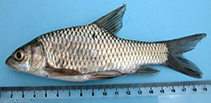
Environnement : milieu / zone climatique / profondeur / gamme de distribution
Écologie
; eau douce benthopélagique; potamodrome (Ref. 138143); profondeur 0 - 50 m (Ref. 34291). Tropical
Africa: known from the Middle Akagera (Ref. 27626), Rusizi River, Lake Kivu, Lake Edward, Lake George, Lake Victoria and Lake Kyoga drainages, and northern part of Lake Tanganyika (Ref. 27626, 107916).
Longueur à la première maturité / Taille / Poids / Âge
Maturité: Lm 54.0 range ? - ? cm
Max length : 90.0 cm TL mâle / non sexé; (Ref. 27626)
Description synthétique
Clés d'identification | Morphologie | Morphométrie
Épines dorsales (Total) : 3; Rayons mous dorsaux (Total) : 9 - 11; Épines anales: 2 - 3; Rayons mous anaux: 5 - 6. The anterior barbel reaches the middle of the eye but in general, it is very short, not reaching the anterior side of the eye; the posterior barbel always reaches beyond the anterior eye, sometimes including the anterior side of the operculae; lips well-developed. Sometimes, an outgrowth is present on the snout (Ref. 27626).
Body shape (shape guide): fusiform / normal.
In Lake Victoria drainage: adults are found in inshore waters and affluent rivers (Ref. 4903, 34290). Young occur in shoals (Ref. 36900) in riverine habitats while adults occur in both riverine and lacustrine habitats (Ref. 34291). Mature individuals swim upstream to spawn (Refs. 36900, 87863), probably in swift, rocky upper reaches of rivers (Ref. 34291). Food consists of gastropod molluscs, insects, plants, fishes and crustacea (Ref. 12526). In lakes Edward and George: in shallow water (Ref. 4903). Oviparous (Ref. 205). A food fish for humans (Ref. 4537), but not of great economic importance (Ref. 4903).
Cycle de vie et comportement reproducteur
Maturité | Reproduction | Frai | Œufs | Fécondité | Larves
De Vos, L. and D.F.E. Thys van den Audenaerde, 1990. Description de Barbus claudinae sp. n. (Cyprinidae) avec synopsis des grandes espèces de Barbus du Rwanda. Cybium 14(1):3-25. (Ref. 27626)
Statut dans la liste rouge de l'IUCN (Ref. 130435: Version 2025-2 (Global))
Menace pour l'homme
Harmless
Utilisations par l'homme
Pêcheries: pêcheries vivrières; pêche sportive: oui
Outils
Articles particuliers
Télécharger en XML
Sources Internet
Estimations basées sur des modèles
Indice de diversité phylogénétique (Réf.
82804): PD
50 = 0.5000 [Uniqueness, from 0.5 = low to 2.0 = high].
Bayesian length-weight: a=0.01023 (0.00506 - 0.02069), b=3.04 (2.87 - 3.21), in cm total length, based on LWR estimates for this species & (Sub)family-body (Ref.
93245).
Niveau trophique (Réf.
69278): 3.4 ±0.52 se; based on food items.
Résilience (Réf.
120179): Faible, temps minimum de doublement de population : 4,5 à 14 années (Preliminary K or Fecundity.).
Vulnérabilité de la pêche (Ref.
59153): High vulnerability (56 of 100).
🛈
Nutriments (Ref.
124155): Calcium = 85.5 [50.9, 150.4] mg/100g; Iron = 1.19 [0.78, 1.82] mg/100g; Protein = 17.6 [16.8, 18.5] %; Omega3 = 0.468 [0.199, 1.100] g/100g; Selenium = 97.1 [41.6, 211.3] μg/100g; VitaminA = 52.5 [20.3, 128.2] μg/100g; Zinc = 1.46 [1.07, 2.05] mg/100g (wet weight);