Umwelt: Milieu / Klimazone / Tiefenbereich / Verbreitungsgebiet
Ökologie
seewasser demersal. Tropical
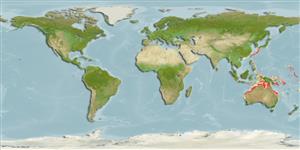
Western Pacific: northwestern Australia (Ref. 5978) and Papua New Guinea.
Größe / Gewicht / Alter
Geschlechtsreife: Lm ? range ? - ? cm
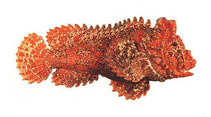
Ventral surface of lower jaw smooth, no prickles or papillose villi. Mandibular cirri almost confined to outer margin. Snout with large, fleshy, and extensively branched cirri; those in larger patches on tip of snout and across lachrymal bone large while those in smaller patches on nasal bone are smaller. Fleshy pad on isthmus with its width about 0.5 to 0.75 of its length (Ref. 39602).
Body shape (shape guide): elongated.
Found inshore, in soft bottom (Ref. 75154).
Lebenszyklus und Paarungsverhalten
Geschlechtsreife | Fortpflanzung | Ablaichen | Eier | Fruchtbarkeit | Larven
Kailola, P.J., 1987. The fishes of Papua New Guinea: a revised and annotated checklist. Vol. II Scorpaenidae to Callionymidae. Research Bulletin No. 41, Research Section, Dept. of Fisheries and Marine Resources, Papua New Guinea. (Ref. 6192)
IUCN Rote Liste Status (Ref. 130435: Version 2025-2 (Global))
Bedrohung für Menschen
Harmless
Nutzung durch Menschen
Tools
Zusatzinformationen
Download XML
Internet Quellen
Schätzungen auf der Grundlage von Modellen
Bevorzugte Temperatur (Ref.
123201): 24.3 - 28.6, mean 27.2 °C (based on 302 cells).
Phylogenetischer Diversitätsindex (Ref.
82804): PD
50 = 0.5078 [Uniqueness, from 0.5 = low to 2.0 = high].
Bayesian length-weight: a=0.00631 (0.00252 - 0.01577), b=3.13 (2.91 - 3.35), in cm total length, based on LWR estimates for this (Sub)family-body shape (Ref.
93245).
Trophische Ebene (Ref.
69278): 3.4 ±0.3 se; based on size and trophs of closest relatives
Anfälligkeit der Fischerei (Ref.
59153): Low vulnerability (10 of 100).
🛈