Environnement : milieu / zone climatique / profondeur / gamme de distribution
Écologie
; eau douce pélagique. Tropical; 11°S - 21°S
Africa: Middle and Lower Zambezi, including Lake Kariba, and Pungwe and Buzi rivers in Mozambique (Ref. 52193). Reports from Congo River basin refer to other species of Distichodus (Ref. 96324, 122092).
Taille / Poids / Âge
Maturité: Lm ? range ? - ? cm
Max length : 57.0 cm SL mâle / non sexé; (Ref. 52193); poids max. publié: 7.6 kg (Ref. 52193)
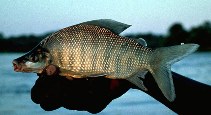
Épines dorsales (Total) : 0; Rayons mous dorsaux (Total) : 27 - 29; Épines anales: 0; Rayons mous anaux: 14 - 15. Diagnosis: snout extended; mouth terminal; head about 4 times in fork length; juveniles with 6-7 dark bars (Ref. 52193).
Body shape (shape guide): fusiform / normal.
Inhabits swift flowing water, rapids or quiet, deep, sandy or rocky pools (Ref. 13337). Found only in the mainstream of larger rivers and even in Lake Kariba prefers more riverine habitats; omnivorous, feeds on insects, snails, small fish, and aquatic plants; breeds in summer, moving upstream to suitable sites (Ref. 7248, 52193).
Cycle de vie et comportement reproducteur
Maturité | Reproduction | Frai | Œufs | Fécondité | Larves
Daget, J. and J.-P. Gosse, 1984. Distichodontidae. p. 184-211. In J. Daget, J.-P. Gosse and D.F.E. Thys van den Audenaerde (eds.) Check-list of the freshwater fishes of Africa (CLOFFA). ORSTOM, Paris and MRAC, Tervuren. Vol. 1. (Ref. 7094)
Statut dans la liste rouge de l'IUCN (Ref. 130435: Version 2025-2 (Global))
Menace pour l'homme
Harmless
Utilisations par l'homme
Pêcheries: intérêt commercial mineur; pêche sportive: oui
Outils
Articles particuliers
Télécharger en XML
Sources Internet
Estimations basées sur des modèles
Indice de diversité phylogénétique (Réf.
82804): PD
50 = 0.5000 [Uniqueness, from 0.5 = low to 2.0 = high].
Bayesian length-weight: a=0.01445 (0.00677 - 0.03085), b=3.08 (2.90 - 3.26), in cm total length, based on LWR estimates for this species & Genus-body shape (Ref.
93245).
Niveau trophique (Réf.
69278): 3.2 ±0.49 se; based on food items.
Vulnérabilité de la pêche (Ref.
59153): Moderate to high vulnerability (48 of 100).
🛈