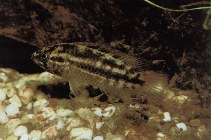
>
Cichliformes (Cichlids, convict blennies) >
Cichlidae (Cichlids) > Cichlinae
Etymology: Nannacara: Latin, nannus = small + Greek, kara = face (Ref. 45335).
More on author: Regan.
Taxonomic Remarks
Redescribed in Kullander & Nijssen (1989: 199), based on Surinamese material, with bibliography, diagnosis, description, distribution, and illustrations.
Entorno: milieu / zona climática / rango de profundidad / gama de distribución
Ecología
; agua dulce bentopelágico; pH range: 6.0 - 8.0; dH range: 5 - 19. Tropical; 22°C - 25°C (Ref. 1672)
South America: Aruka River in Guyana east to the lower Marowijne River in Suriname.
Tamaño / Peso / Edad
Madurez: Lm ? range ? - ? cm
Max length : 5.6 cm SL macho / no sexado; (Ref. 36377)
Frequently occurs in flooded savannas of the coastal zone (Ref. 27188). Feeds on worms, crustaceans and insects (Ref. 7020). Quite popular among aquarists who breed it without difficulty. Males are larger and more colorful, possessing more distinctly more elongated unpaired fins (Ref. 35237). Aquarium keeping: several females for one male; minimum aquarium size 80 cm (Ref. 51539).
Ciclo vital y comportamiento de apareamiento
Madurez | Reproducción | Puesta | Huevos | Fecundidad | Larva
During spawning the female changes its color to a chess-board pattern, which is apparently recognized by the young. Only the female takes care of the (up to 300) eggs and young, the male may defend the larger territory (Ref. 40602).
Kullander, S.O. and H. Nijssen, 1989. The cichlids of Surinam: Teleostei, Labroidei. E.J. Brill, Leiden, The Netherlands. 256 p. (Ref. 26372)
Situación en la Lista Roja de la UICN (Ref. 130435: Version 2025-2 (Global))
Amenaza para el ser humano
Harmless
Usos humanos
Pesquerías: comercial; Acuario: Comercial
Herramientas
Informes especiales
Descargar XML
Fuentes de Internet
Estimaciones basadas en modelos
Índice de diversidad filogenética (Referencia
82804): PD
50 = 0.5156 [Uniqueness, from 0.5 = low to 2.0 = high].
Bayesian length-weight: a=0.01445 (0.00665 - 0.03141), b=3.08 (2.90 - 3.26), in cm total length, based on LWR estimates for this (Sub)family-body shape (Ref.
93245).
Nivel trófico (Referencia
69278): 3.3 ±0.40 se; based on food items.
Resiliencia (Referencia
120179): Alto, población duplicada en un tiempo mínimo inferior a 15 meses (tm<1).
Vulnerabilidad pesquera (Ref.
59153): Low vulnerability (10 of 100).
🛈